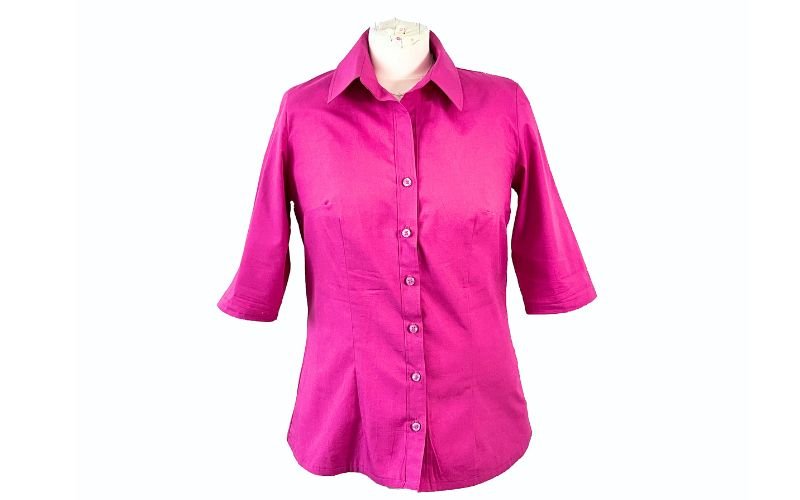
In this post, I show you how to sew a grown-on shirt button stand step by step, using a method that creates a crisp, straight finish every time. This is the easiest type of button stand to sew and is the most commonly used method in commercial sewing patterns.
Whenever I sew a shirt, I always start with the button stand before any other construction step. In my experience, sewing the button stand first keeps it straight and prevents distortion caused by later steps like darts or collar attachment.
This button stand sewing tutorial is suitable for confident beginners who want to move into structured garment construction.
I am using the self drafted shirt sewing pattern, but this method works equally well with commercial sewing patterns.
If you have not drafted your button stand yet, I show the full process in my button stand and placket drafting tutorial, including how to choose the correct width and structure for your shirt.
→ Read: How to Draft a Button Stand and Placket
What This Button Stand Sewing Tutorial Will Teach You
This tutorial shows the exact method I use to sew a button stand from a self-drafted sewing pattern. The same process can be applied to most shirt patterns that include a grown-on button stand.
Sewing Process Overview for Button Stand
The process for sewing a button stand follows these main sewing steps:
- Mark fold lines
- Apply interfacing
- Fold and press
- Topstitch
- Add buttonholes and buttons
Tools and Materials You Need to Sew a Button Stand
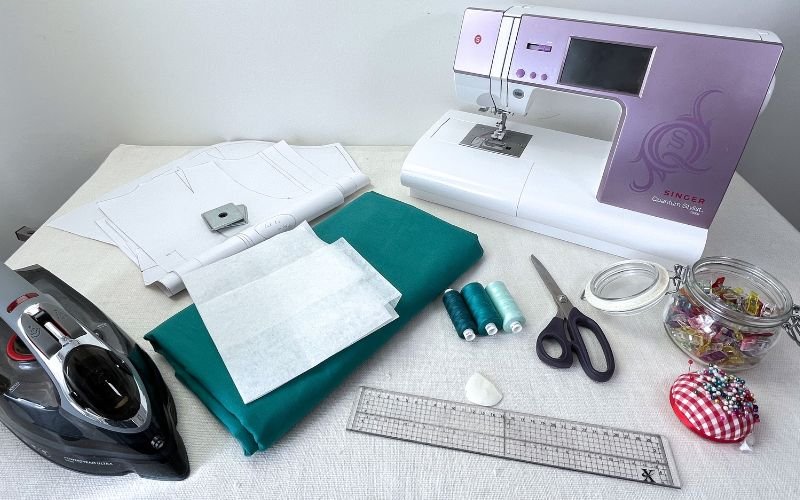
To sew a button stand accurately, you will need these sewing tool and materials. Using the right tools will make your button stand more precise and easier to sew, especially when working with lightweight fabrics.
- steam iron for applying fused interfacing and crisp folds
- shirt sewing pattern (you can use a self drafted pattern)
- pattern weights
- fabric (lightweight cotton, linen or rayon fabric or any other natural fibres work best, as they press well and hold a crisp edge)
- fusible interfacing
- matching thread
- soap, fabric tracing pen or chalk
- grading ruler if the seam allowance is not included or a long ruler for making fold lines
- scissors
- pins or clips
- sewing machine
Step by Step of Sewing Button Stand
If you prefer a video guide instead, here is my Youtube tutorial where I go through the steps on how to sew a buttonstand:
Step 1: Prepare the Fabric
Before you trace your sewing pattern, make sure that the fabric has been prepared. My post on how to pre-wash and prepare fabric for sewing lists all the steps and reasons why this is necessary for natural fibres.
I always pre-wash natural fibres for close fitting garments to prevent shrinkage after sewing.
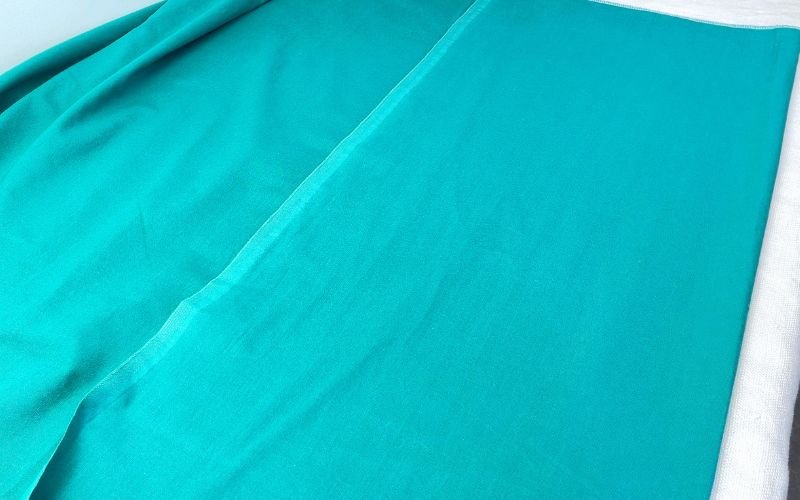
Then iron the fabric to create a smooth surface. Any wrinkles and folds will change the dimensions of the fabric and will affect the precision of the shirt construction. So you want to make sure that the fabric is pressed properly.
Step 2: Trace the Sewing Pattern
Useful Tip
When I trace my sewing patterns, I always trace the pattern pieces that need to be cut on fold first. For a shirt pattern that is a back pattern piece. Then the other pieces can be arranged in the available spaces in a single layer, mirroring the pattern for pieces that are not symmetrical – the front and the sleeves.
This approach reduces fabric waste. However, for a directional print fabrics you will need to consider the surface pattern placement.
Trace and cut the front sewing pattern that includes the button stand. If you are unsure how the button stand is constructed within the pattern, refer to my button stand and placket drafting tutorial where I break down the structure and key differences.
→ See the drafting guide: How to Draft a Button Stand and Placket
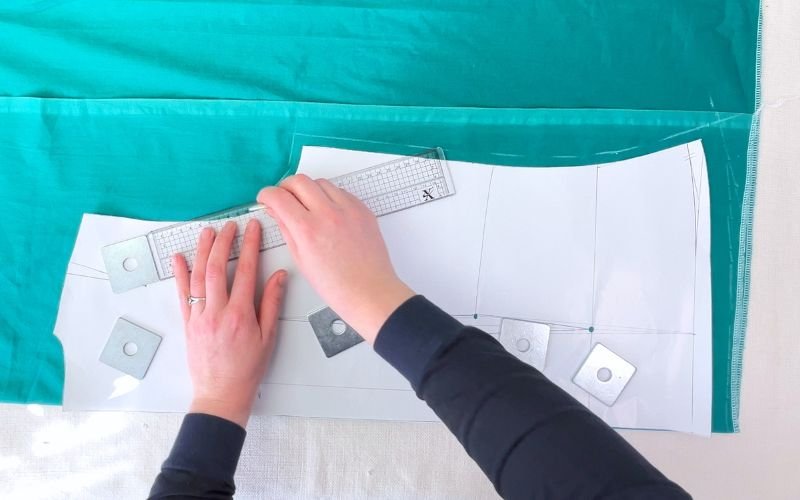
I do not include seam allowances in most of my pattern pieces, so I add them during tracing using a grading ruler. This gives me more control over seam accuracy, especially on curved edges. Accurate marking at this stage directly affects how straight your finished button stand will be.
You can get the seam allowance cheat sheet from my how to add seam allowances post.
NB!
The seam allowance is not required for the button stand long edge as that is already included within the button stand.
If you cut the fabric in single layer, then for the other front pattern piece, you can use the first cut out fabric piece as a guide for a quicker workflow.
Or repeat the same steps above but place the pattern piece upside down to cut a mirrored pattern piece.
Step 3: Mark the Button Stand Fold Lines
Next, within the seams allowance on the wrong side of the fabric, mark the location of the two fold lines at the neckline and at the hem.
Then connect the end points with a straight line, using a long ruler or a grading ruler.
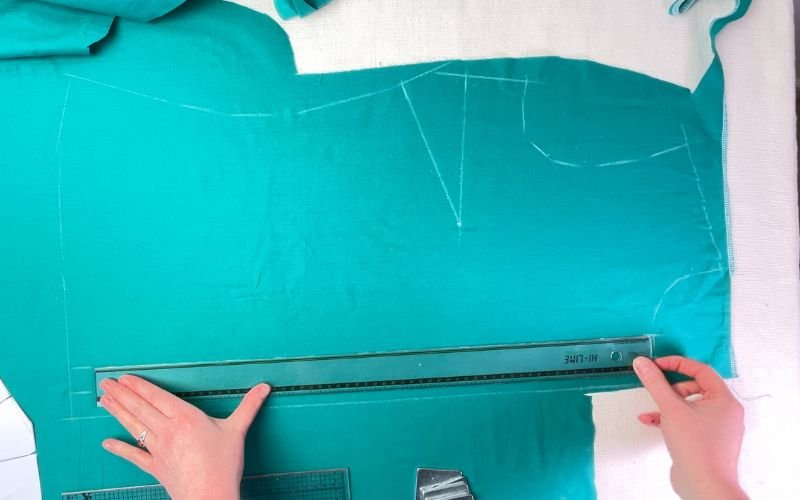
If you are using a grading ruler, measure the width of each fold on the sewing pattern and then mark the lines from the edge of the button stand on the fabric.
Step 4: Cut Fusible Interfacing
You need to cut a fusible interfacing strips that are exact width or slightly narrower than the width of the finished button stand. I find that cutting a narrower width leads to a precise finish while exact width may make the button stand a few mm wider due to the extra fabric at the fold lines.
The easiest and quickest way to cut the fusible interfacing strips is by folding the fusible interfacing and then cutting the match shorter strips with tracing wheel and a quilting ruler. This way the strips are also more precise.
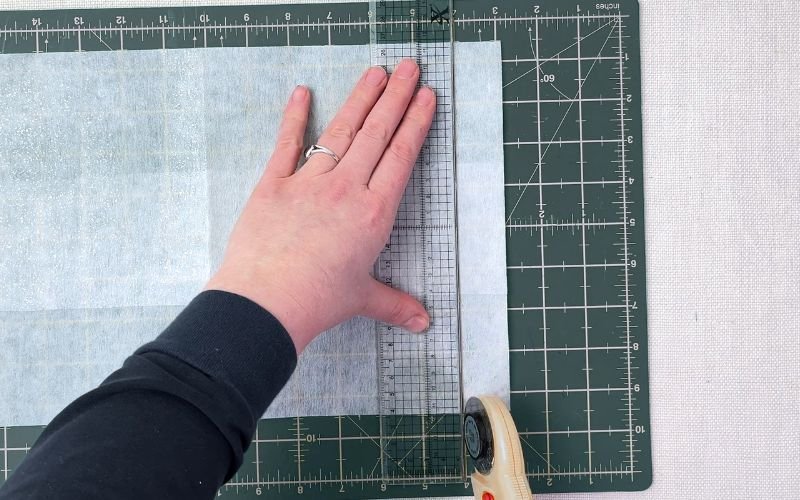
Precision here matters — uneven interfacing will show in the final button stand.
Step 5: Apply Fusible Interfacing
Next, position the fusible interfacing strip between the button stand fold markings on the wrong side of the fabric. You should not apply the fusible interfacing within seam allowance at the neckline and the hem to reduce the bulk.
Press with a hot iron. Do not glide the iron, just hold it in place and lift it to move to the next section. This way the fusible interfacing will not move out of place.
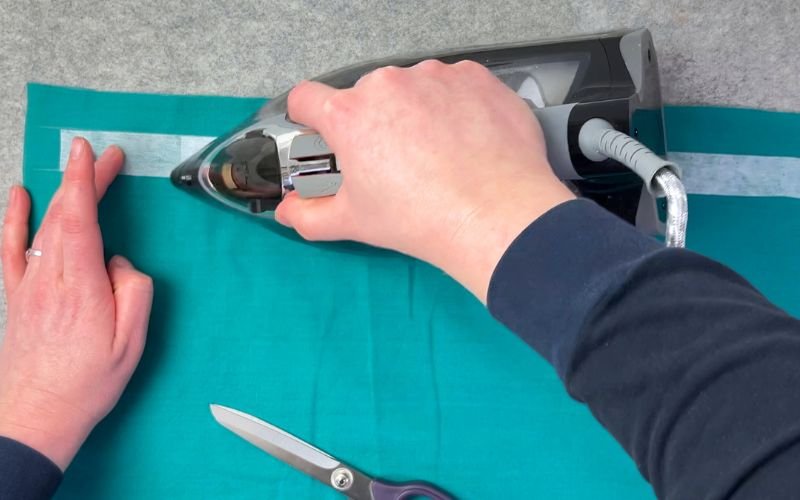
While most instructions recommend a medium heat without steam, I get better results using a hot iron with steam — just test on a scrap first to avoid damage. You just need to be careful not to melt the interfacing and the fabric.
If your fusible interfacing strip is shorter than the button stand, then you can add the missing section with a new strip, slightly overlapping the previous one.
Step 6: Fold and Press the Button Stand
Now you can use the fusible interfacing as a guide to fold and press the button stand in place. Fold up the button stand edge over the fusible interfacing. Press it in place with a hot steam iron.
Fold it over again and press in place.
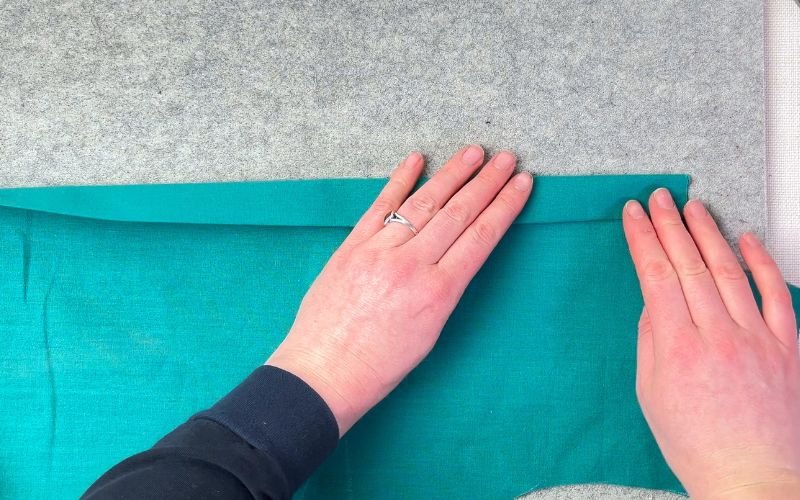
Accurate sewing is largely about pressing — this is what gives the button stand its final shape.
Step 7: Pin and Sew the Button Stand
Next, pin or clip the button stand to reduce the movement or misalignment. I prefer to use clips for the button stand instead of the pins.
Pins create tiny holes that can be tricky to remove if the fabric is delicate or the pins are too thick. And, since the button stand is a visible part of the fabric, I try to remove any imperfections at the garment construction stage.
Once pinned (or clipped) move to the sewing stage.
You will need to sew the button stand from the right side. This is trickier as you cannot see the inside edge of the button stand. While it is possible to sew from the wrong side, the bobbin thread may cause some uneven stitching. In most cases, when the bobbin tension is off, the bobbin thread gets tangled and it can be more difficult to correct it later.
Sewing from the right side gives you a cleaner topstitch finish, even though it requires more control.
To make life easier, you can either draw a stitching line with a removable fabric marker or soap from the right side or carefully hand baste the stitching line. Be mindful that neither option are truly removable – the fabric market may leave a light marking even after removal and the hand stitching may introduce some holes if the sewing needle was too large. The soap option is less likely to leave a mark.
I prefer to just sew close to the inner edge, feeling for the ridge with the tip of my fingers and keeping the fabric as straight as possible.
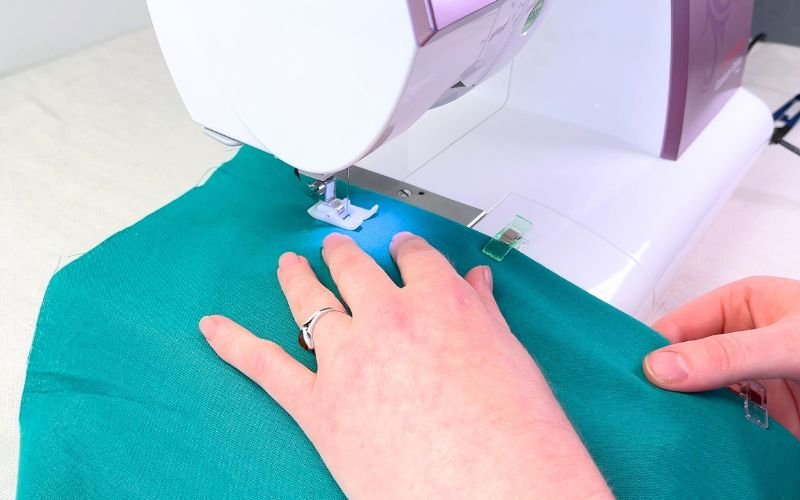
When sewing the second front bodice piece, start from the same edge as the first – either the neckline or hem. This will reduce misalignment if the fabric moves as both sides will move in the same direction.
However, it can be tricky to guide the fabric under the sewing arm as you will have more fabric on the right side of the needle. Here, the issues with the fabric bulk management may outweigh the benefits of the directional sewing.
Step 8: Press the Button Stand
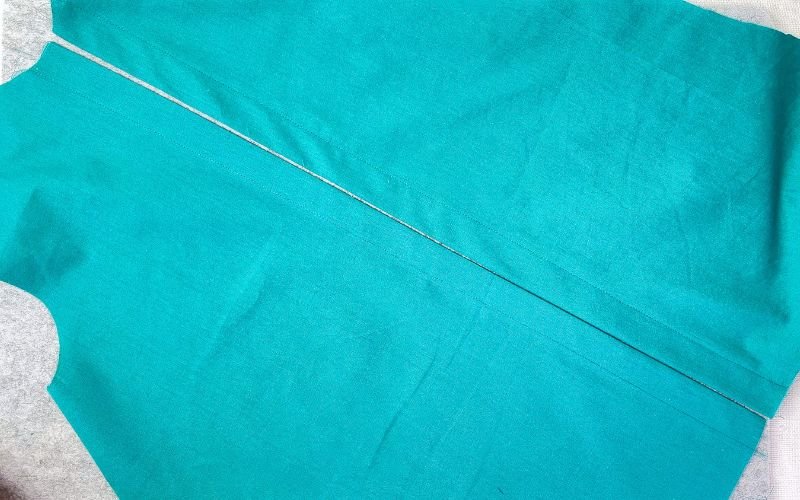
Once the button stand is sewn, press it again, blending the stitches. While it seems there are so much pressing already, this step will ensure that the finished button stand stay crips and wave free.
In my example below, you can see the difference between the pressed and unpressed button stand. The left side is pressed after sewing while the right side has not been pressed.
Step 9: Mark the Buttonhole Locations
While the buttonhole markings is the next step to finish the button stand, it is not actually my preferred next chronological step.
I add the buttonholes and the buttons once the shirt is fully completed. This way the location of the buttons are more precise and work with the collar buttonhole better. Correct button placement is key to preventing gaping and ensuring a balanced shirt front.
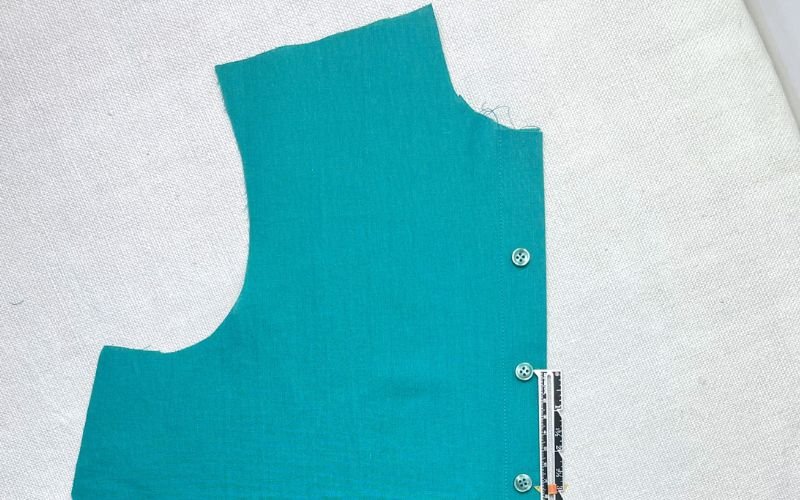
To mark the buttonhole location, first find the location of your bust apex and mark the first buttonhole at this level. This will reduce the fabric gaping at the bust.
I like to use buttons to plan the location of buttonhole. They can be easily removed and readjusted without leaving markings on the fabric.
Then place the reminder of the buttons in equal distance. I first position the buttonholes above the bust level as there are going to be less buttons. Once you are happy with the location, measure the distance between the buttons and mark the same location between all of them across the whole button stand.
Good to Know
Typically, the buttons are placed with 7-9 cm gap. The actual location will depend on the proportions of the body and how many buttons you can fit above the bust without overcrowding or being too sparse. In my case, I have 2 buttons (plus a collar button) above the bust.
Step 10: Sew the Buttonholes
In my post on how to sew buttonholes on sewing machine I provide detailed step by step instructions for four different methods of sewing buttonholes.
The easiest method is using the automatic one step buttonhole stitch on the sewing machine if your machine comes with this option.
Regardless of which method you use, sew and finish the buttonholes before marking the matching location for the buttons. This way you can adjust the location of each button, ensuring that the final garment match up at the hem and the neckline.
Always test your buttonhole settings on scrap fabric before sewing on the garment.
Step 11: Sew on the Buttons
Once you have completed the buttonholes, start adding the buttons. You can sew the buttons by hand or using a special button foot on your sewing machine. I will add a future post on how to sew buttons with a sewing machine.
Start with the collar button. Once that has been added, fasten the button and mark the location of the next button through the buttonhole. Then sew the next button at that exact location. Fasten it and mark the next one. Repeat the process until you have attached all the buttons.
This method leads to buttons matching with buttonholes perfectly, without any gaping or bunching between the buttonholes. It also compensates for small inaccuracies and ensures the shirt closes cleanly from top to bottom.
If the buttonholes were sewn on at the precise location on the previous step, then the marking of each button once the previous one has been fastened is not necessary. However, in reality, there most likely will be a few mm difference between the buttonholes due to fabric shifting or stretching. My method ensure that the button stands match up perfectly at the collar and the hem without any step change.
Common Button Stand Sewing Mistakes
These are common button stand sewing issues that I have experienced and the suggestions on how to fix them:
- The button stand is not straight or crisp after sewing.
- Cause: The button stand was not pressed.
- Fix: Press the button stand thoroughly before and after sewing to set the folds.
- The button stand is too soft and does not hold its shape
- Cause: The interfacing was not used
- Fix: Use light interfacing between file lines to create structured shape.
- The button stand is too stiff and rigid.
- Cause: The interfacing is too heavy for the fabric.
- Fix: Use a light interfacing or an interfacing that is similar weight to the fabric.
- The seam line is not capturing the folded edge of the button stand.
- Cause: you did not follow the edge of the buttonstand when sewing.
- Fix: mark the location of the button stand folded edge with a fabric marker, soap or baste it in place.
- There are small puncture holes in the button stand
- Cause: Pins were too wide for the fabric.
- Fix: use clips instead of pins. Steam iron the button stand to minimise the appearance of the holes.
Shirt Sewing Series
This post is part of a larger step by step shirt pattern drafting and sewing series.
- How to draft a shirt pattern from scratch for beginers
- How to sew a shirt button stand (this post)
- How to trace and sew darts
- How to sew and attach a collar and collar stand to a shirt
- How to attach a shirt placket
- How to sew shirt cuffs step by step for beginners
- How to sew shirt sleeves
- How to sew a shirt
I recommend following these steps in order if you are drafting and sewing a shirt from scratch.
FAQ: Button Stand Sewing
Conclusion
Sewing a button stand is one of the foundational skills in shirt making, and once you understand the process, it becomes a quick and repeatable step in your workflow.
The key to a clean result is not speed, but precision — accurate marking, careful pressing, and controlled stitching make the biggest difference.
Once your button stand is complete, you are ready to move on to the next stage of shirt construction, such as darts, collars, and sleeves.
If you are following along with my shirt sewing series, continue with the next step to build your shirt from start to finish with a consistent method.
About the Author: Pattern Drafting & Garment Sewing

I’ve been sewing for over 30 years and drafting my own patterns for more than a decade. I work almost exclusively with self-drafted patterns, which means I don’t rely on instructions—I rely on understanding how garments fit and come together.
Most of my methods come from figuring things out through testing, adjusting, and breaking down common problem areas using logic and geometry rather than guesswork.
On this site, I share step-by-step tutorials on pattern drafting, garment construction, and sewing techniques to help you create well-fitted, professional-looking clothes from scratch.
👉 Read more about my approach to pattern drafting and sewing here: About Me