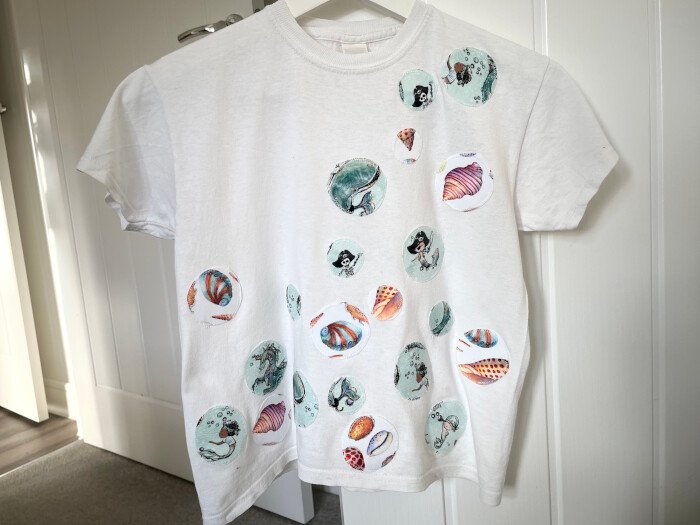
Every year BBC organises a charity event in the UK called “BBC Children in Need“. This is supported by majority of schools. The school to which my offspring goes to, raises donations by allowing children to go to school in spotty clothes. Every year, without a fail, I am unprepared. With one week to go and limited time to explore outside of the home, and after cancelling Prime subscriptions (we are trying to keep the costs down due to torrid times), I am looking at the skills I have as a way out.
I made a Hungry Caterpillar dress for my child once with appliqué so this might be a good project to refresh the skills and create something fun.
What you need for this Spotty T-Shirt
- Old T-shirt that first your child. You can upcycle your own T-shirt or look for the one from the child’s wardrobe. You could even use a T-shirt that has stains as you can cover the stain with an appliqué.
- Fabric offcuts. They do not need to be large pieces. The appliqué pieces can be various sizes so anything goes. I am going to stick to cotton jersey but any fabric scraps will do.
- Lightweight fusible interfacing. Ideally it should be for knit fabric but I only had a woven type so I used that for my project.
- Compass or various round shapes, like bottle caps, small saucers, toiler roll tube or you can even go without any of that and rely on steady hand.
- A paper on which to draw shapes (this is optional as you can draw directly on fusible interfacing).
- A chalk or heat erasable pen. A graphite pencil will work in a pinch too.
- Matching thread
- Scissors
- Sagery pins, pins and/or washable glue stick
- Iron and ironingboard
- Sewing machine with zig zag stitch option
How to prepare the old T-shirt
Start by washing the T-shirt if it is dirty. You could even dye the T-shirt with fabric dye. Then wash and properly iron it. Less creases and smoother the garment, the easier it will be to sew on the spotty patches.
Cutting colourful spots from fabric scraps
You will need to create a template circles to use for tracing onto the fusible interfacing. I used some round objects that I have lying around my sewing space. My aim is to create two different sized spots so I used to templates. I was considering using a third smaller shape but I was concerned tjat it might be tricky to sew around it so I went for shapes that are around 5 and 3 cm in diameter.
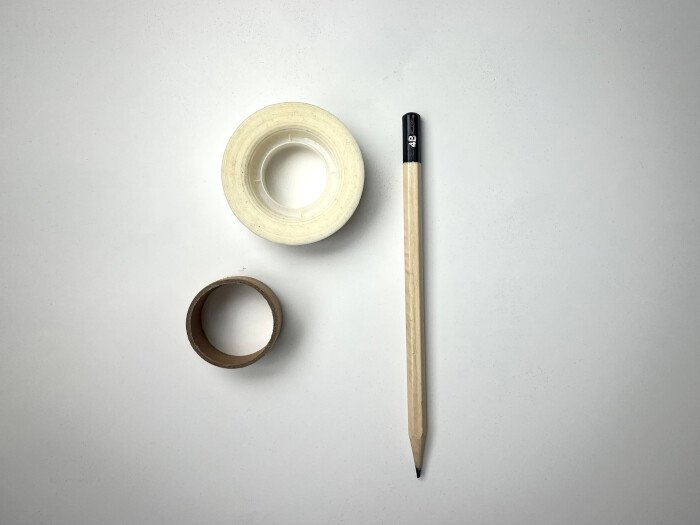
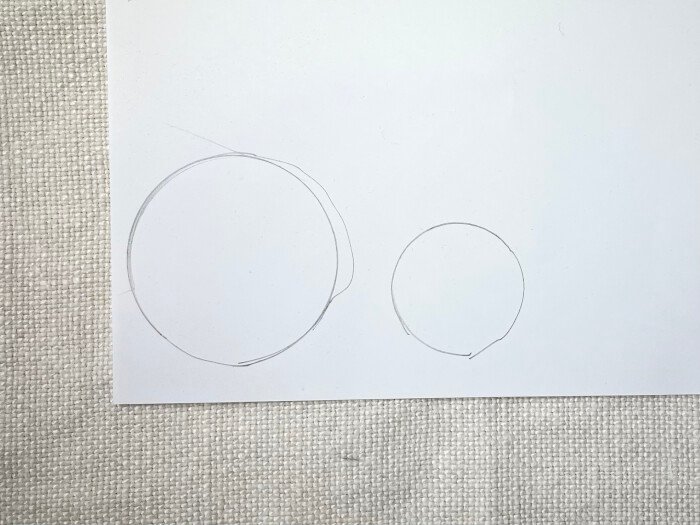
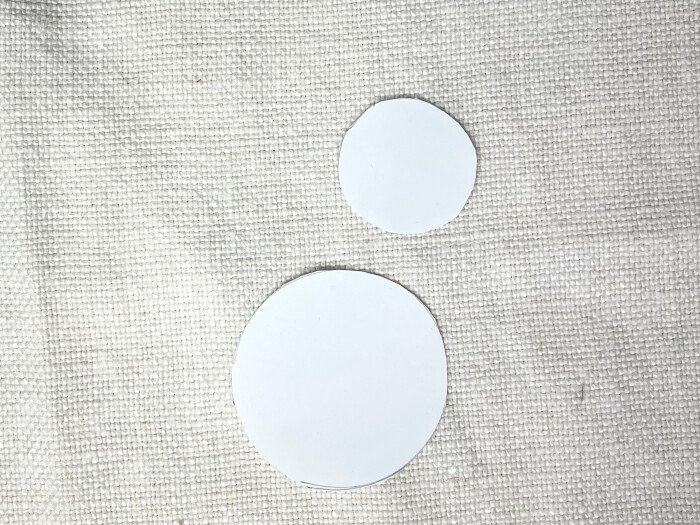
Next, trace the shapes on the smooth side of the interfacing (the side without the glue). It does not really matter on which side you draw but it will be easier to draw on the smooth side and not on the glue spots. You could cut out as many or as little shapes that you want.
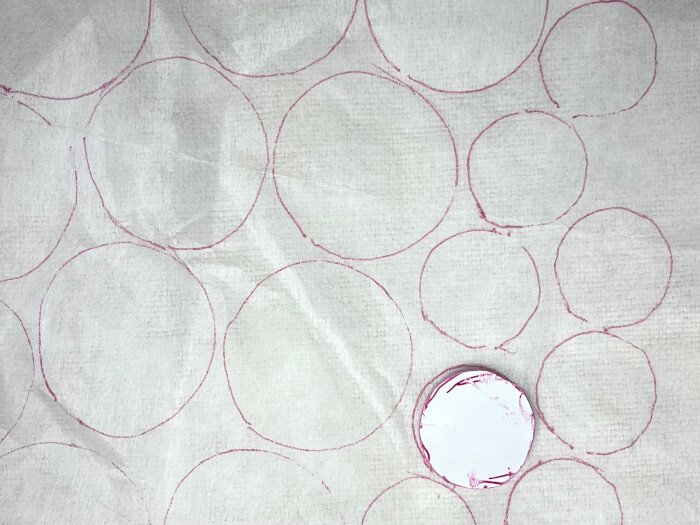
Carefully cut out the spots.
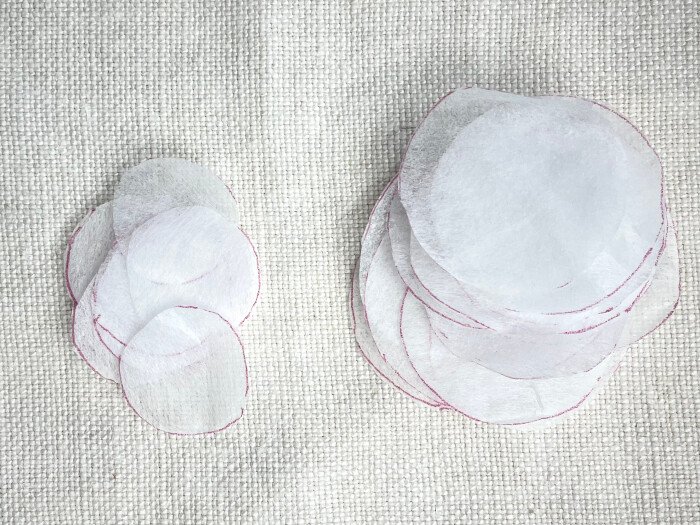
Then, place them with the glue side down on the wrong side of the fabric offcuts, arranging to capture the patterns that you want or do it haphazardly. You can use arttistic license here 🙂 I place a few at a time and then press with a hot iron without steam to secure.
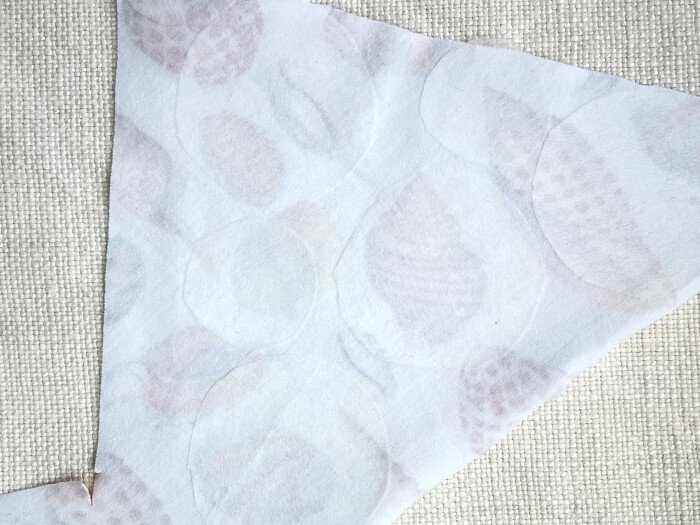
Once you have pressed and glued all the circles on the fabric, cut the shapes carefully with scissors.
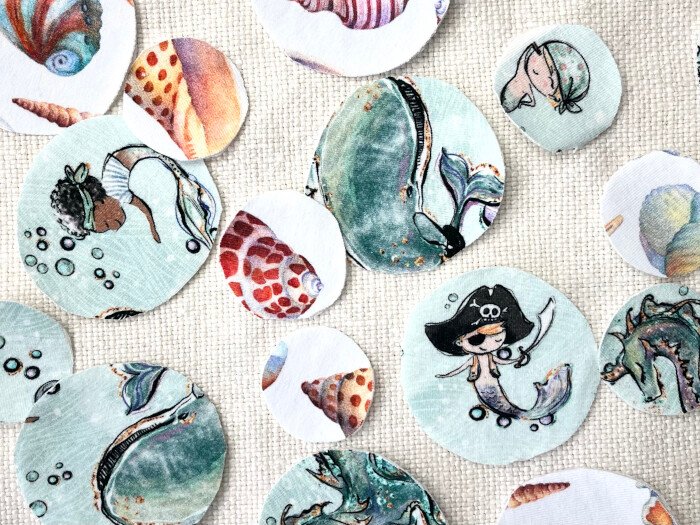
How to arrange the spots for a fun design for a spotty t-shirt
Seperate the circle appliques by size and colour hues or shades. This will make it easier to create a seamless design and makes the process enjoyable.
There are various methods for composition, including a rule of thirds and curves amongst many others. A blog post from Work Over Easy provides a beginners guide while Jackson’s Art provides some useful tips.
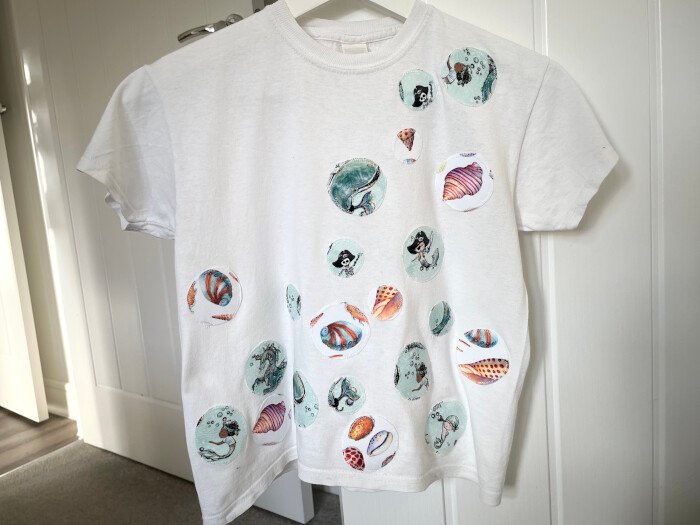
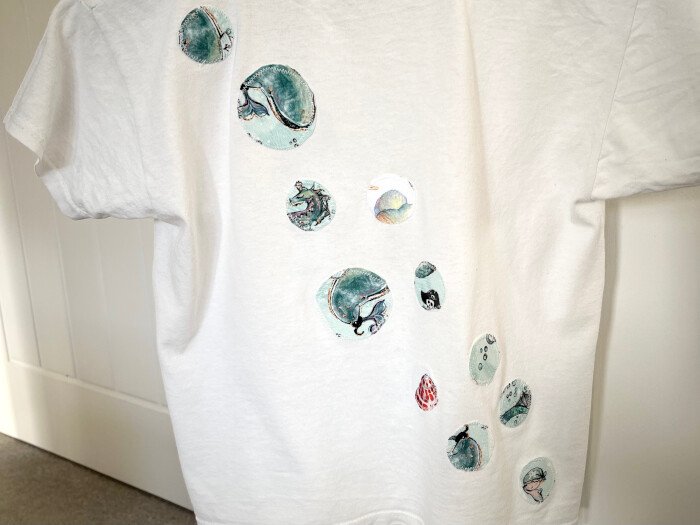
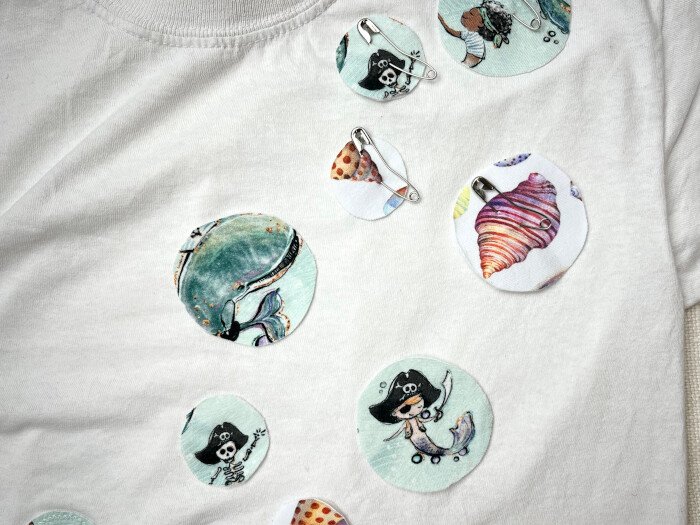
I organised the applique in somewhat curved S shape, arranging the pieces in a manner where the paler colour circles are evenly distributed amongst the darker sea green circles. I started with larger circles first and then filled the space with the smaller ones.
As I was arranging the pieces, I attached them to the T-shirt with curved safety pins.
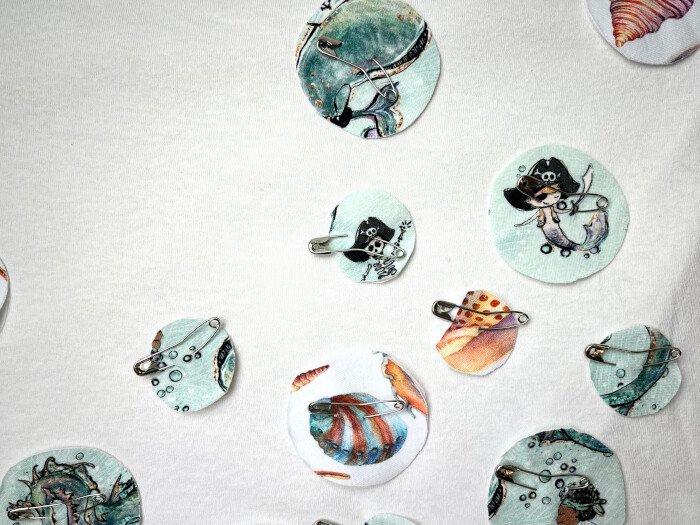
For the back pieces that I was going to sew first as a warmup, I attached the circles directly with glue stick, by dabbing a little bit of glue to the centre of the appliqué.
Easy ways to attach the spots (sewing or no-sew)
Depending of the time you have available and the longevity you would like to achieve from the spots, you could attach all the spots with just a PVA glue, especially if you the T-shirt has really reached the end of its useful life and would end up as a rag immintently.
The PVA glue option can also be considered if you wanted to reuse the T-shirt later on without the spots. PVA glue is a water soluble glue so you would need to soak the T-shirt in some warm water for the spots to come right off.
If you are using just the glue, make sure you attach the spots on the other side of the spotty T-shirt only once the first side has dried. You will also need to be careful not to glue the front to the back. The T-shirt might also turn to be a little hard where you dabbed the glue.
But this would not be a sewing blog if I endorsed the glueing on the spots.
Easy sewing method to attach the spots
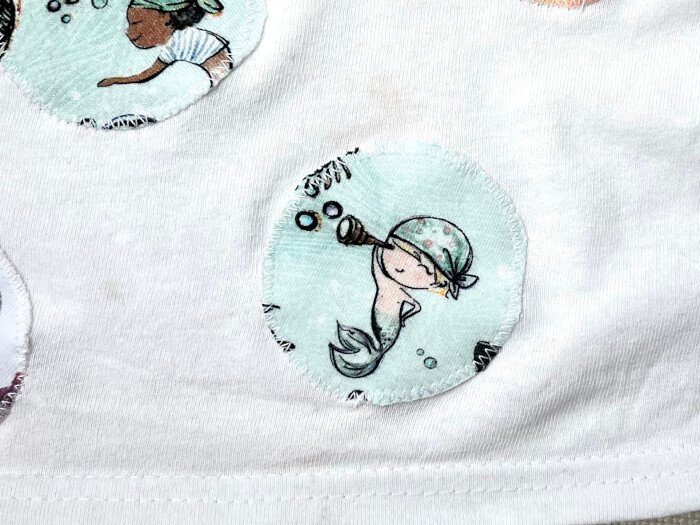
My method involves sewing the spots on with a sewing machine, Set your sewing machine to a zig zag stitch, 3 mm wide and 1.2 mm long. Start by sewing the spots that you have temporarily glued on with a glue stick. Sew all around it, turning the T-shirt as you sew to capture the raw edges of the appliqué pieces. Once you have come round to the start of the stitching, sew over the first stitched and backstitch a little to secure the thread.
Then lift a pressure foot and without cutting the thread, move to the next spot that has been temporarily glued down and carry on stitching.
Once you have sewn all the pieces that have been secured on with a glue stick, remove the pins from further 4-5 pieces and glue them onto the T-shirt with a glue stick.
When you have sew on all the circles, you will be left with a few threads to trim on both the inside and outside of the spotty T-shirt.
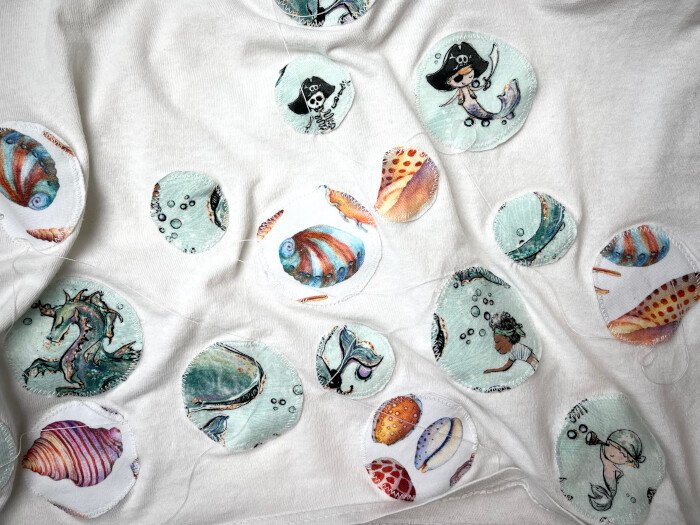
Then carefully iron the T-shirt.
Finishing touches for a durable kids’ T-shirt
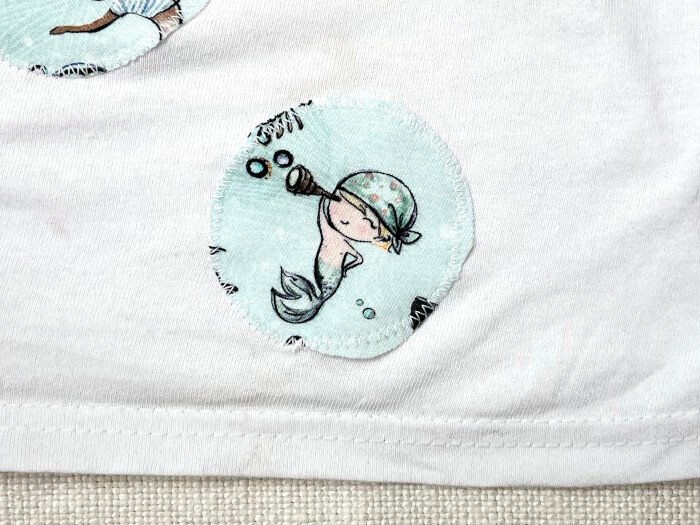
This project does not require a perfectionist approach. The garment most likely will be used once a year for the BBC Children in Need charity event and then for a casual wear outside of a formal setting. However, to ensure the longevity of the spotty T-shirt, I recommend trimming the appliqué edges that have not been fully covered by a seam.
Thus, any fabric that may tend to unravel would be secure and you would not need to worry about the spots coming undone through the wear.
Washing and Care Tips for the finished spotty T-shirt.
The great thing about a spotty T-shirt it can get extra stains and not be that noticeable. Even if a bigger stain appeared, you can easily sew on another appliqué piece to cover it.
In terms of wash routine, th T-shirt can be washed on a regular cycle with other clothes of similar colour (together with dark colour laundry if the T-shirt was dark and the ligh colours if the T-shirt was light).
if there are any discolouration, you can add an oxygen bleach to the main wash compartment or dry the T-shirt on the line outside in a direct sunlight.
Why scrap-fabric crafts are great for BBC Children in Need charity event
As I was sewing the spots onto the T-shirt, I kept thinking of the benefit this particular project will bring.
Firstly, I am redirecting fabric scraps from the waste. While I tend to use up bigger scrap pieces for various smaller garments, there are always a lot of tiny pieces that I would otherwise just chuck in the bin. These now would be all used up for this task.
Secondly, I can now donate the money that I would have spent sourcing a spotty T-shirt. While there are official BBC Children in Need spotty T-shirts for sale, only a fraction of the price of the T-shirt are directed towards the charity as the seller must recoup the costs of making and distributing the garment. If I make the T-shirt myself, I am not buying anything extra. I only spend my time but since the sewing is my past time (and presumably, yours too), then this is a win-win undertaking.
Thirdly, my child will wear something that is different to other children. Depending on the age and upbringing, they may see it that way too.
Fourthly, I am teaching my children that you do not need to spend the money. With a little bit of imagination one can achieve great things.