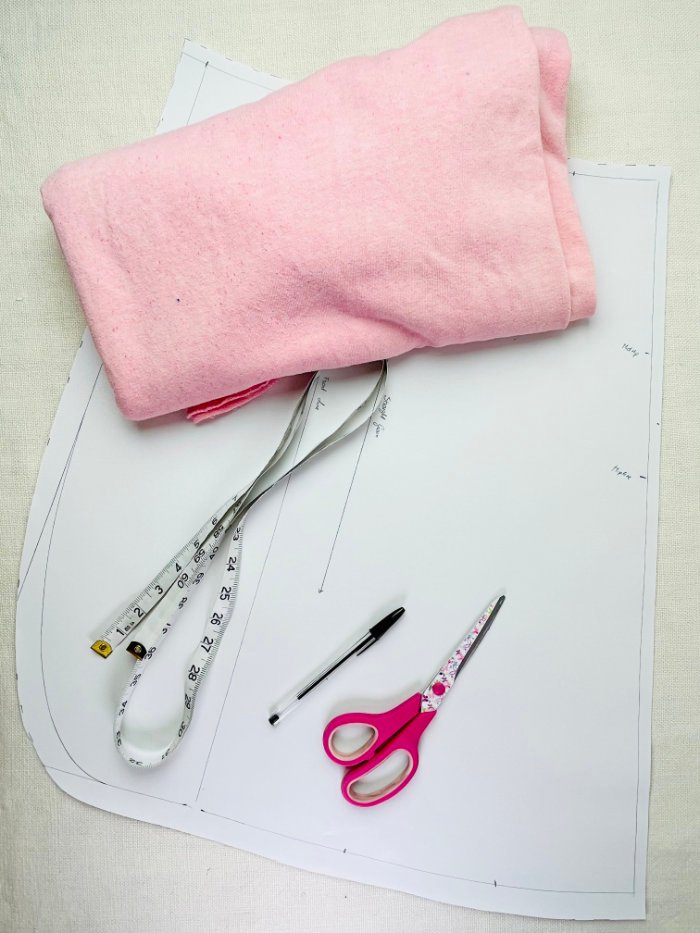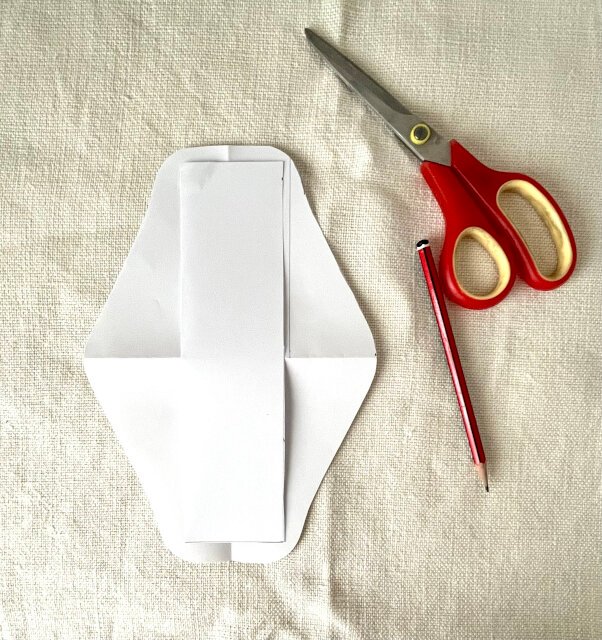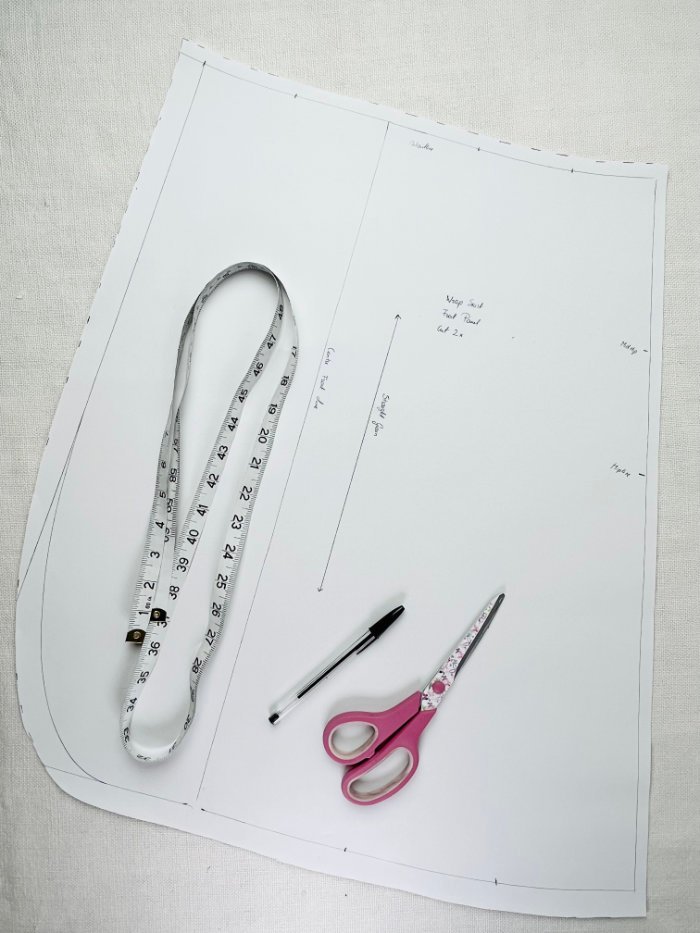
A wrap skirt is one of the simplest and most practical modifications you can make to a basic A-line skirt block. In this beginner-friendly pattern drafting tutorial, I’ll show you how to draft a custom wrap skirt sewing pattern step by step, from a basic A-line skirt block.
This method requires no darts, no zip, and no complex closures, making it ideal for first-time pattern drafting while still producing a well-balanced, wearable garment. By the end of the tutorial, you’ll have a complete, custom-fit wrap skirt pattern ready for sewing.
What Is a Wrap Skirt? (Pattern Drafting Basics)
A true wrap skirt does not require complicated closure options. It relies on waist ties to secure the skirt on the body by simply wrapping it around the waist. That means that there is no need for a zip or button closers or any special tools. A faux wrap skirt, on the contrary, requires other closure options and more complicated sewing techniques that might be a bit challenging to beginners.
The A-line skirt base works perfectly because it is simple and does not have any waist darts. The resulting wrap skirt will be comfortable to wear and you could even move the wrap section to a side rather than a front without affecting the fit.
One of the biggest advantages of a wrap skirt is long-term wearability. Because the fit is adjustable, the same garment can adapt to seasonal layering, body changes, and even maternity wear, extending its useful life and reducing the need for replacement garments.
What You Need Before You Start
To draft the wrap skirt, you will need:
- Finished A-line skirt pattern
- Pattern drafting tools (paper, tape measure, pencil and set square ruler or a quilters ruler with clearly visible squared lines)
- Waist measurement and an idea of desired overlap
How Much Overlap Does a Wrap Skirt Need?
When drafting a wrap skirt, overlap is a drafting decision rather than a fixed measurement. Because the skirt flares toward the hem, the amount of coverage changes depending on where you measure. For that reason, I always assess overlap at the hem first, then confirm it at the waist.
A wrap skirt needs an overlap to ensure that it does not turn into a cape. The overlap width depends on personal choice on how much modesty you need and the design of the finished wrap skirt.
I measure the overlap at the hem rather than a waist because a tapered overlap will have different coverage compared to a straight edge overlap.
For reliable coverage in everyday wear, I recommend drafting the wrap overlap to approximately two-thirds of the front panel width, measured at both the waistline and the hem. This provides enough coverage for walking and sitting without excessive fabric bulk.
A full overlap (equal to the entire front panel width) is possible, but it often causes the hem to sit unevenly and uses more fabric than necessary.
Drafting the Wrap Skirt Pattern (Step-by-Step)
In the below sections I will show you how to draft a wrap skirt pattern step-by-step.
Before You Start
Make sure that your A-line skirt block fits comfortably at the waist and hips.
Step 1 – Trace the A-Line Skirt Block
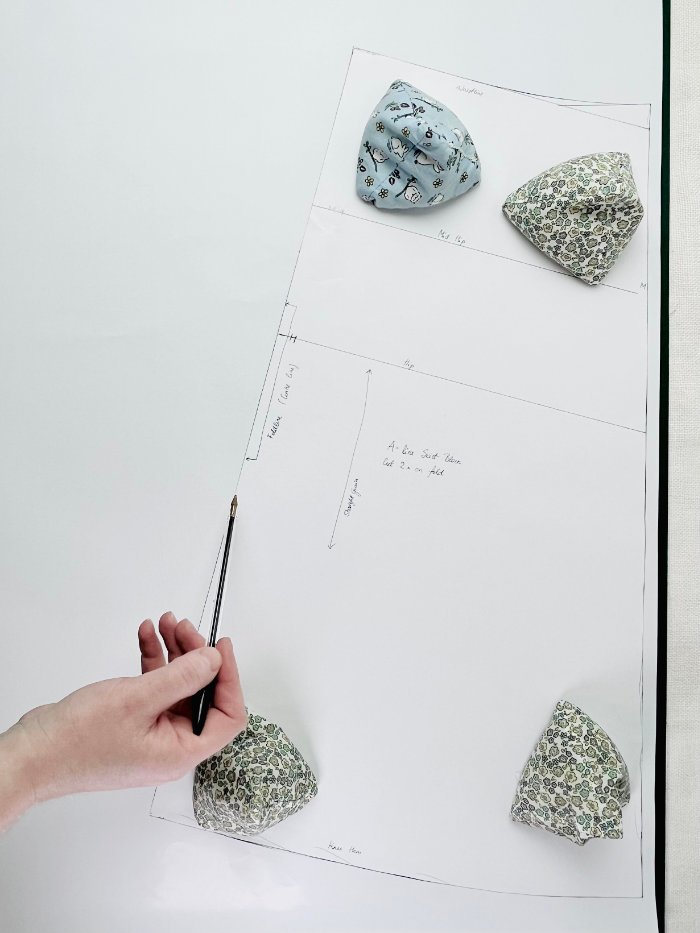
Lay your A-line skirt pattern on a large sheet of paper. I am using A1 flipchart paper for a knee-length wrap skirt. Position the pattern so you have room to add 1 cm seam allowance at the waist and side seams, 2 cm at the hem, and enough space at the centre front to draft the wrap overlap.
Trace around the skirt pattern and remove the A-line skirt pattern draft from the top.
Turn the A-line skirt pattern draft upside down and align the centre fold line with the centre line traced on the paper. Trace around the additional part as far as you have space.
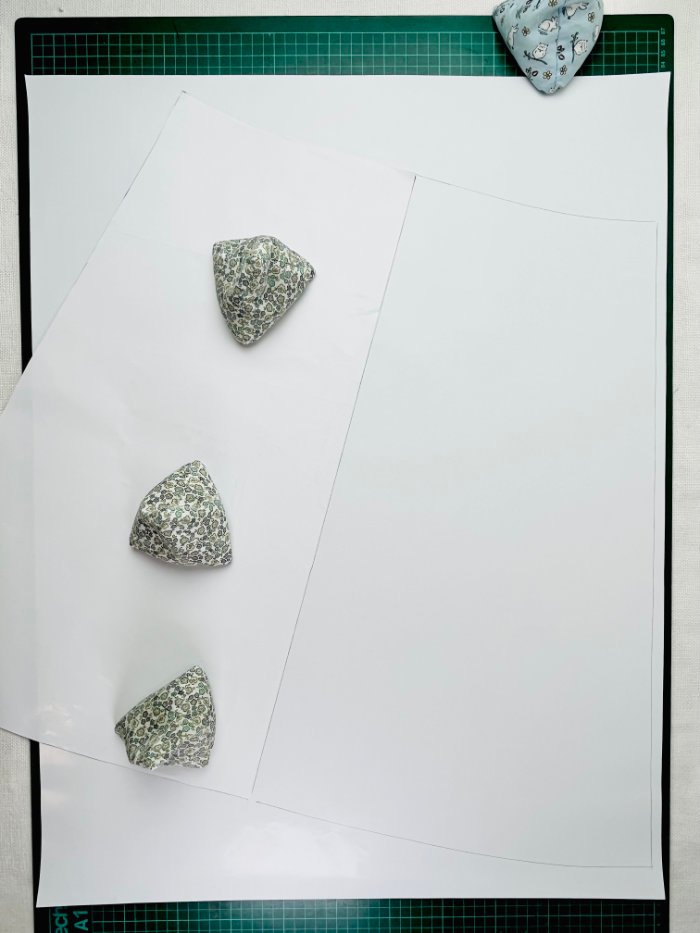
You should get at least 2/3 of the block drafted. If you do not have enough paper then you can glue on or stick on additional paper to the edge to fit the skirt. I did not have enough space to fit 2/3 of the hem but it gave me enough to draft the overlap.
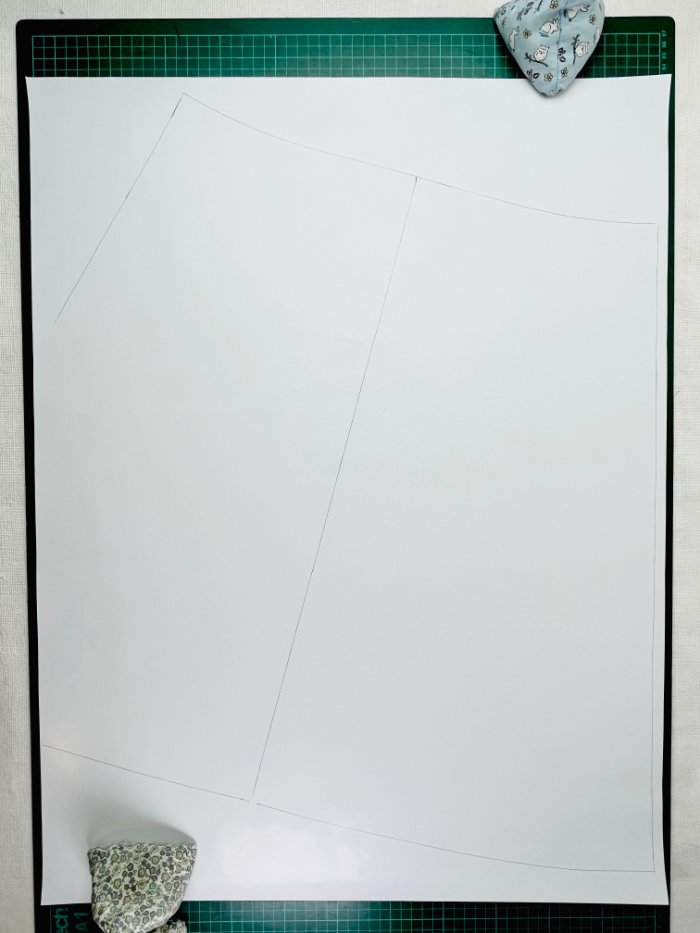
Step 2 – Draft the Wrap Overlap Panels
Our wrap skirt will have symmetrical front pieces so we will need to draft just one overlap pattern piece. You could draft upper and lower overlap sections to be different, with different overlap width, but symmetrical pattern pieces makes it less complicated.
Divide the hem of the first traced skirt block in three equal parts. This does not have to be exact and eyeballing works well. I place two marks on the hem, splitting the hem in three parts.
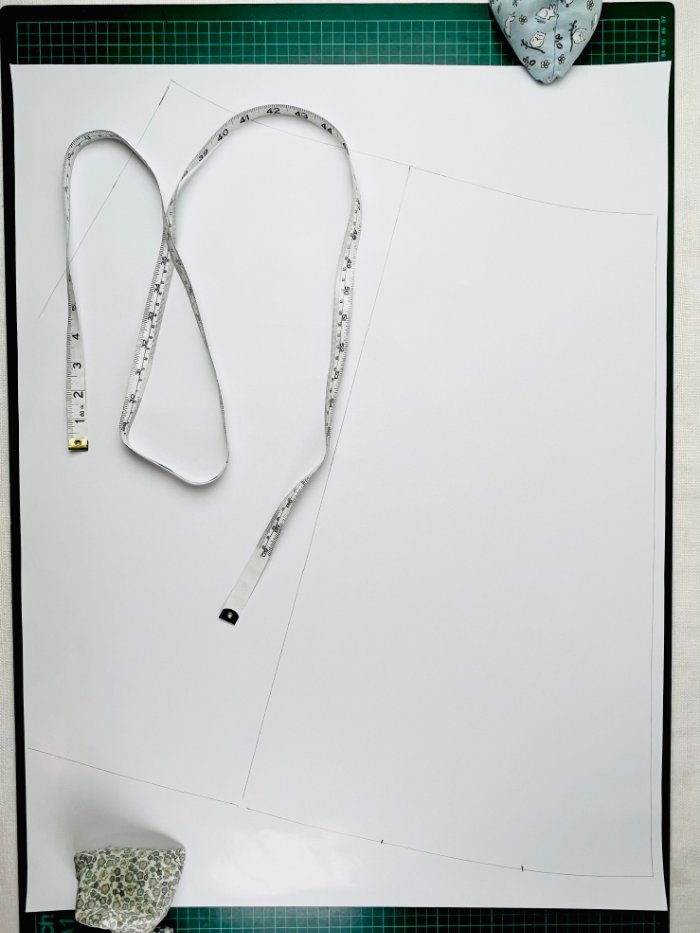
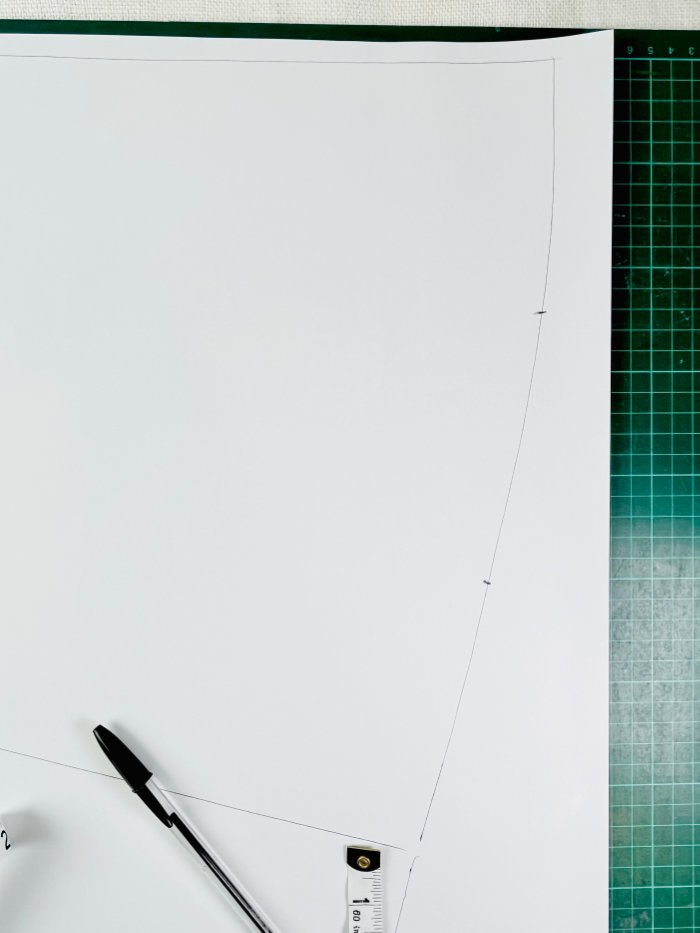
Then measure the distance from the centre line to the second marker (to 2/3 of the hem length).
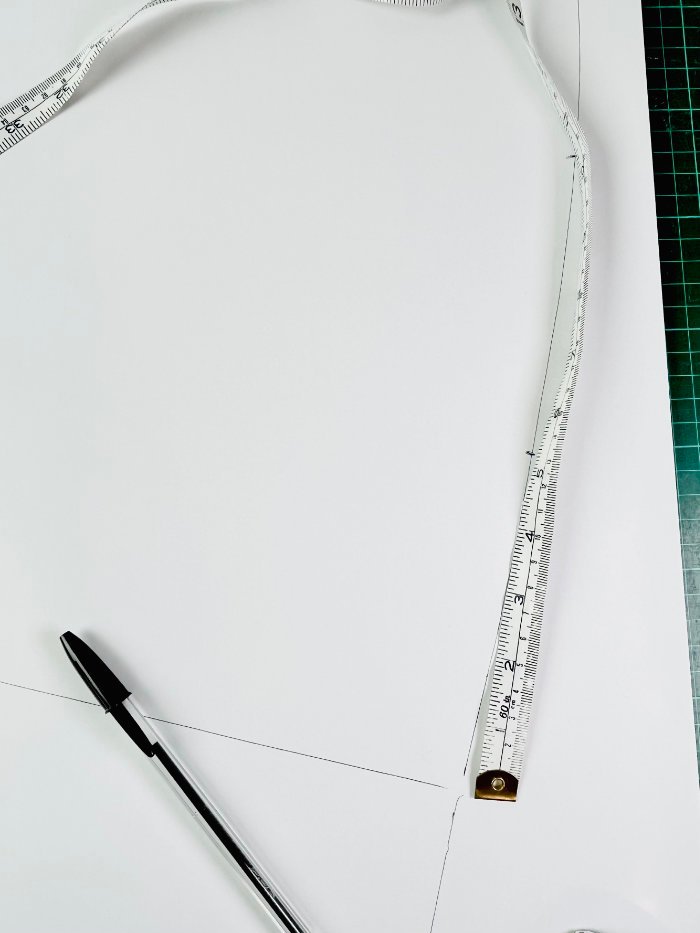
Mark this distance on the extended section, measuring from the centre front fold line.
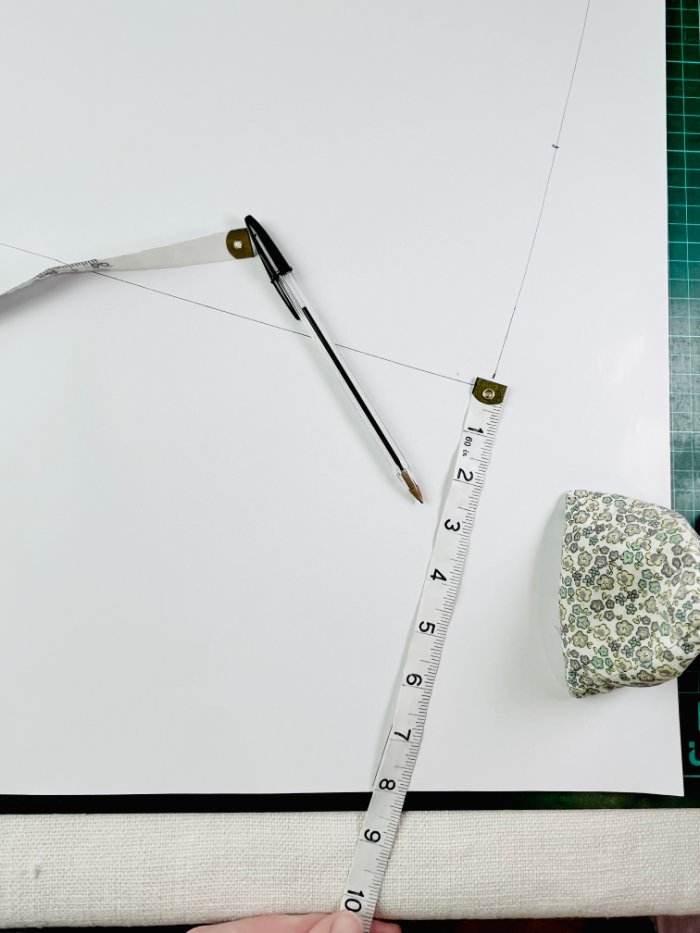
Then repeat the same for the waistline – split it in thirds, measure to the second marker and mark the distance on the extended side. Or, if you manage to extend the skirt for the whole waistline then you can mark the thirds on the extension, skipping the measuring stage.
Connect the 2/3 mark on waistline with 2/3 mark on the hemline with a straight line.
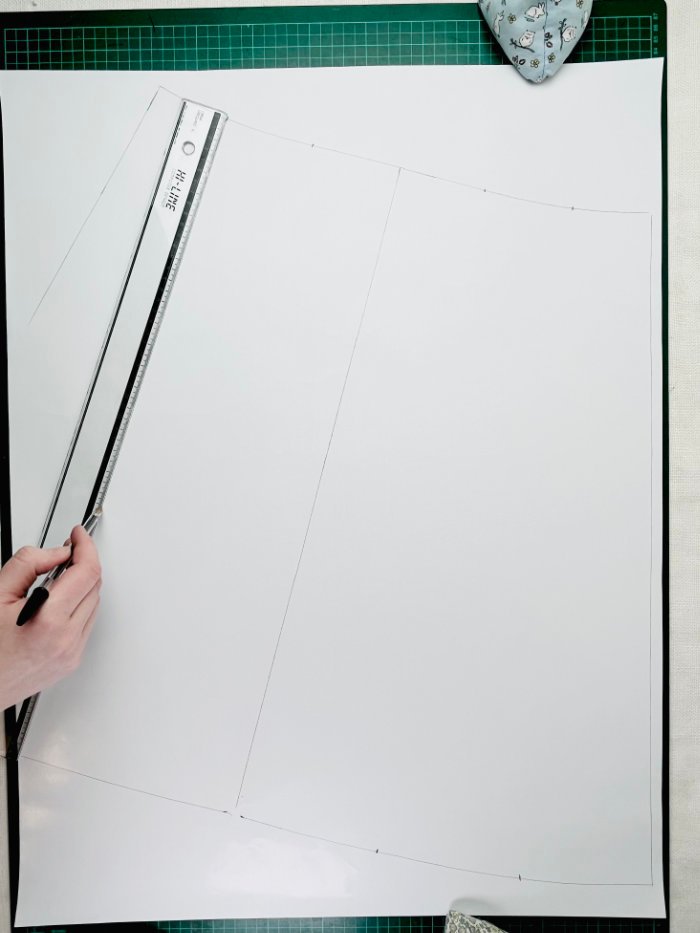
You can keep the overlap as is, but I find it is easier to balance the hemline if the overlap is curved at the hem. You can curve it either with a French curve or freehand. Smoother the transition at the hem, easier it will be to sew the curved edge later on.
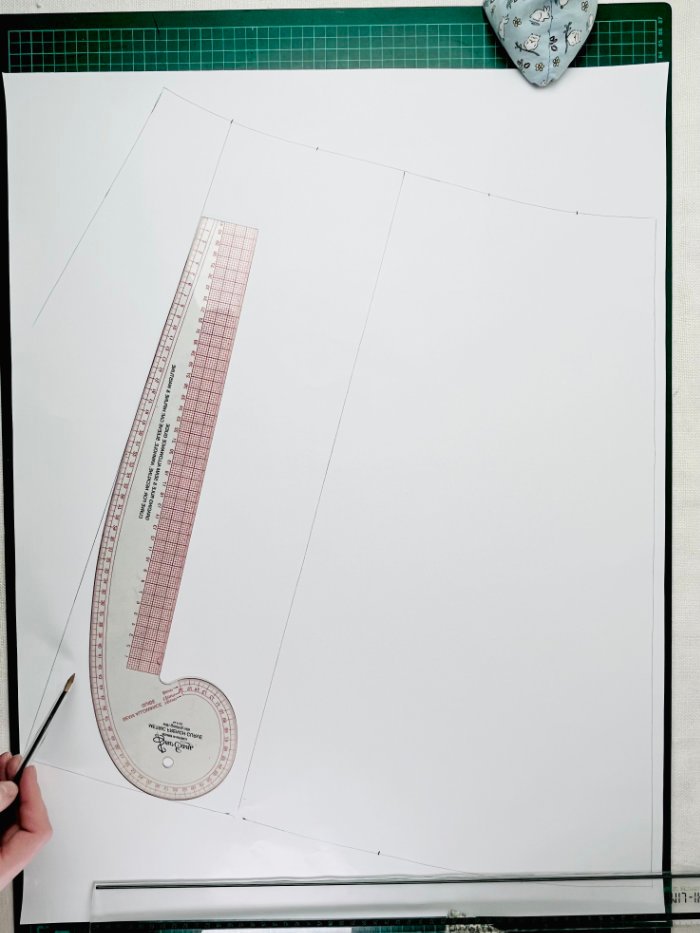
Drafting note: I’ve tested this overlap proportion on multiple body types and fabrics, and the two-thirds guideline consistently balances coverage with movement. If you prefer a slimmer look, reduce the overlap later at the fitting stage rather than during drafting.
Step 3 – Add Seam Allowances and Pattern Markings
Next, you need to add seam allowances to the front panel.
Add 1 cm – 1.5cm seam allowance to the side seam and waistline, and 2 cm seam allowance to the hem and the overlap front edge.
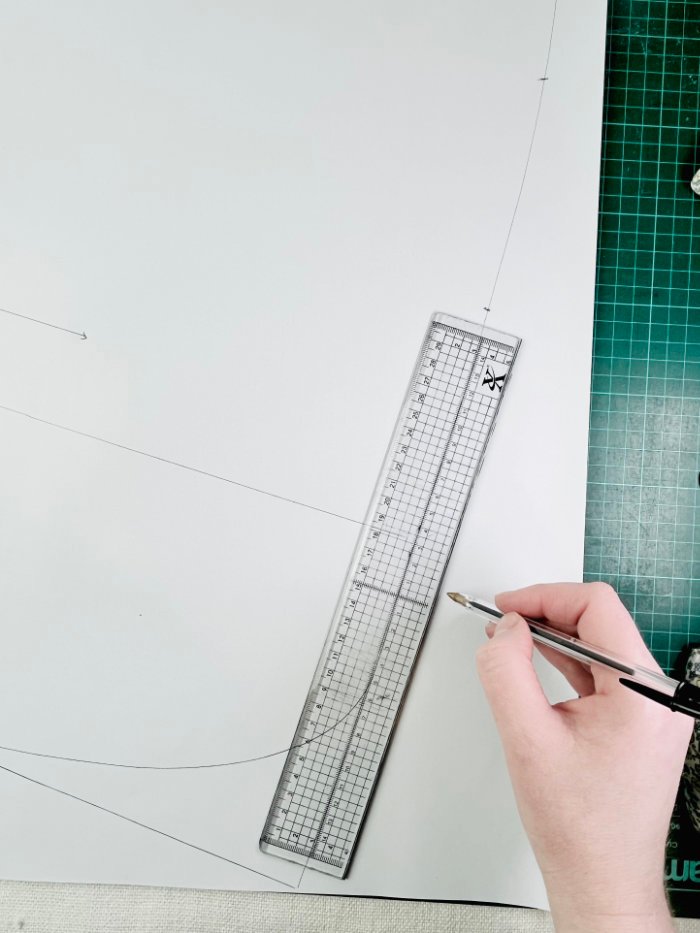
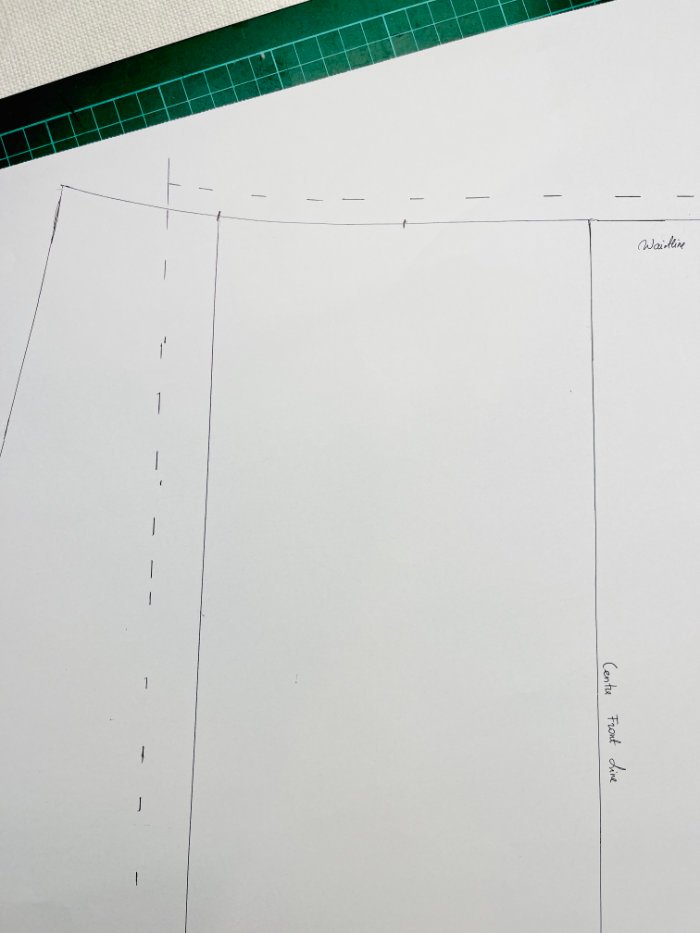
Mark a straight grain line that runs parallel to the centre front line. Make notes that this is Front Panel for a wrap skirt and that you will need to cut two mirrored pieces. I also mark the waistline, mid hip and hip notches on the side.
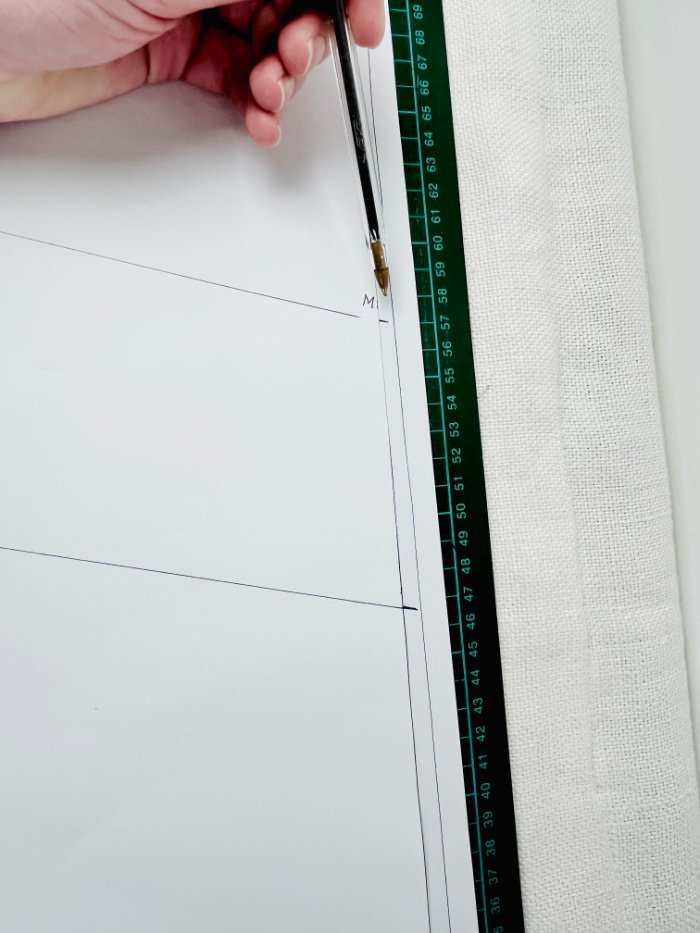
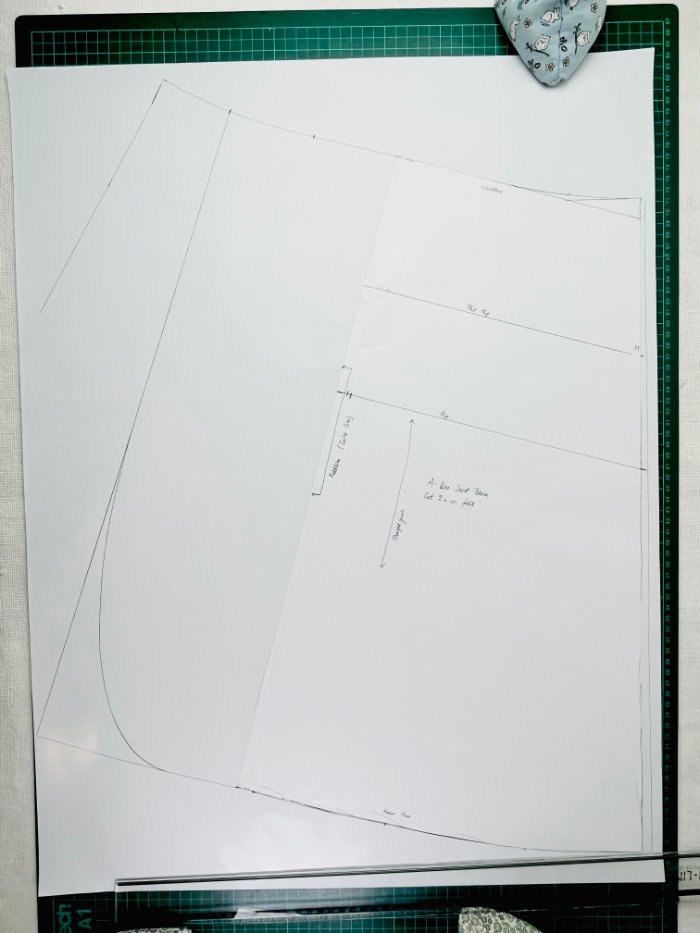
Then cut out the finished pattern piece.
Step 4 – Trace the Back Skirt Pattern
On a separate price of paper, trace another A-skirt block, the same as you did for the front panel. This is going to be your back pattern piece.
Add seam allowances – 1.5cm to the side and 2cm to the hem. You do not need to add the seam allowance to the centre back line as you will be cutting the pattern on a fold. Just don’t forget to mark the centre fold line and add notes that you will need to cut it on fold.
Drafting Waist Ties and Closure Options
The easiest solution for the beginner will be to use tie-closure as that does not require any complicated button or snap closures. Additionally, the ties make the skirt very versatile. Ties allow you to adjust the skirt to your changing dimensions or thicker tops that you may tuck in the skirt.
The ties will extend into the waistband, or, more accurately, the waistband will be extended for tie closure. I do not draft a cut pattern for waistband for wrap skirt but I work out the required length by multiplying the waist measurement by 3. This is the minimum required tie length. In reality, I go for the twice or three times the width of the fabric that I am using for the skirt, whichever give me at least the minimum requirement.
If you prefer to have the wrap skirt tie pattern, then draft a rectangle that is your waist measurement multiplied by 1.6 long and 7 cm wide. Mark that you will need to cut two pieces.
The rectangle should be smaller or exact length of the fabric width to reduce fabric wastage. If the pattern is longer, on the drafted rectangle make a mark that is your waist measurement multiplied by 0.8 from the edge. Then fold the pattern on this line for a narrower fabric and cut three waistband pieces from the fabric (you will need to sew all together to form one long waistband.
Alternatively, you can sew buttonholes on the overlap sides. Then attach matching buttons on the skirt to secure the wrap skirt. You may need to resew the buttons as and when your measurement change.
Design Variations You Can Draft from This Pattern
You can easily adjust this wrap skirt pattern to include a wider waistband, by increasing the width of the waistband. For a 5cm waistband, draft a rectangle that is 13cm wide and either 0.9 or 1.8 times your waist (whichever works with the width of the fabric). Then cut three pieces from fabric for the smaller measurement and two pieces for the longer measurement)
For a longer wrap skirt, after tracing the A-line skirt, extend the side seam and centre front by the required length. Then connect both with a curved line, running parallel to the original hem. The rest of the drafting is the same.
You can change the look and feel of the skirt by simply changing the fabric selection. Rayon will give flowy and light skirt while cotton, linen and hemp will give more structured garment.
Common Wrap Skirt Drafting Mistakes (and How to Avoid Them)
The common wrap skirt drafting mistake that I see is that there is not enough overlap at the centre front, with skirt opening too much when walking. The A-line wrap skirt reduces the chance of the skirt revealing more than intended as there is a flare at the hem. Nevertheless, to be on the safe side, always draft the skirt with 2/3 overlap and adjust later to a smaller overlap if that suits your body type more.
The other mistake that I fell right into myself was having a wrap skirt with an even hemline. It is important to always hang the skirt for at least 24 hours before sewing the hemline. However, some fabrics, such as cotton muslin or gauze, stretch even further after the 24 hours. So, to minimise the uneven hemline, draft the overlap with a curve, minimising the visibility of the overlapped hem.
Fit reminder: Always test the wrap overlap by pinning the paper pattern around your waist before cutting fabric. Small adjustments at the pattern stage save significant time during sewing.
Preparing the Pattern for Sewing
Before you head to cut out the fabric pieces, make sure that you have:
- labelled front and back pieces
- marked hip line placement on back and front pattern pieces
- marked the straight grainline
- added seam allowance
- noted how many pieces of each pattern you need to cut (two front pattern pieces and one wrap skirt back pattern piece cut on fold)
- noted that front pattern piece needs to be mirrored
How to Sew an A-Line Wrap Skirt (Next Tutorial)
On my next blog post on How to Sew an A-Line Wrap Skirt (Step-by-Step Sewing Tutorial) I will walk you through the sewing step by step, explaining how to sew side seams, attach waistband and ties and sew the hem.
Wrap Skirt Pattern Drafting FAQ
Conclusions
This wrap skirt pattern is a practical foundation you can return to again and again. With small drafting changes, it adapts easily to different fabrics, lengths, and styling needs, making it a reliable addition to a handmade wardrobe built on reuse and thoughtful design.
Because this wrap skirt is drafted from an A-line block, it integrates seamlessly into a modular pattern drafting system that supports long-term, slow fashion sewing.