Why I Drafted My Own Laptop Bag
In this blog post, I document my first laptop bag pattern drafting process step by step, sharing real measurements, drafting decisions, mistakes, and practical fixes learned while drafting and testing the pattern.
This tutorial is written from hands-on experience drafting the pattern from scratch for a real 14″ laptop, not from adapting an existing commercial bag pattern.
With a return to work soon looming after a maternity leave, I finally decided to make a laptop bag for my smaller 14″ laptop. The fabric for it I procured ages ago from a boutique online fabric store and I have been itching to turn the water resistant canvas into a laptop bag. Upon looking up the various pattern for laptop bag, I could not quite find something that I wanted so decided to draft my own, without prior bag pattern drafting experience.
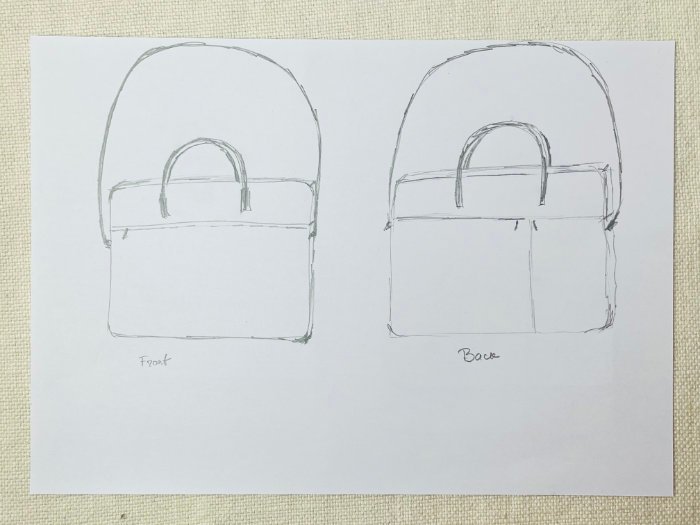
This laptop bag pattern has an outside zipped pocket for laptop cables, two zipped pockets on the other side for sandwiches and my phone. I do realise that this might sound like something from Paddington 🙂 The laptop bag will also have a shoulder strap and handles.
Who This Laptop Bag Drafting Tutorial Is For
This laptop bag pattern drafting tutorial is designed for confident beginners and intermediate sewists who want to learn how to draft a bag pattern from measurements rather than relying on a commercial sewing pattern. Basic sewing knowledge and familiarity with seam allowances and zips is recommended.
Laptop Bag Design & Features (Custom 14″ Laptop Sewing Pattern)
I drafted the laptop bag with everyday office commute in mind. So the bag needs to include pocket for keys, mobile phone, cables and home packed sandwiches.
The laptop bag sewing pattern is made to fit a 14″ laptop. The bag itself is slightly larger, to make it easy to remove the laptop from the bag, so the bag dimensions are 24 cm (9.5″) high, 36 cm (14″) wide and 4 cm (1.5″) deep.
It comes with a shoulder strap and two top handles for easy carrying.
The pattern includes pieces for one inner pocket for keys, one large exterior zip pocket for cables, and two smaller zip pockets for home packed sandwich and a phone (or purse). The laptop bag sewing pattern has an option for full lining or bias bound seam finishes. I intend to add padding and interfacing to make the laptop bag structured but flexible.
With all these features in mind, it was clear that I needed to draft the pattern first rather than just cut the fabric and hope that I have made the right decisions. Drafting allows to visualise the final bag and each pattern piece alignment and seam allowance requirements.
Materials & Tools
To draft a laptop sewing pattern, you will need these materials and tools:
- Paper that is larger than your laptop. I used A2 sized paper.
- Pen or pencil. Pencil will allow the lines to be erased if you make mistake.
- Long ruler and set square ruler
- Grading ruler (optional but makes the draft easier)
Step 1: Measuring a 14″ Laptop for Bag Pattern Drafting
You need to take three measurements for your laptop:
- Width – measure from one side of the laptop to the other at its widest part. If you add any USB dongles when carrying the laptop, take this measurement into consideration.
- Height – measure from bottom to the top of the laptop
- Depth – place laptop on a hard surface such as table and measure the depth from the surface to the top of the laptop.
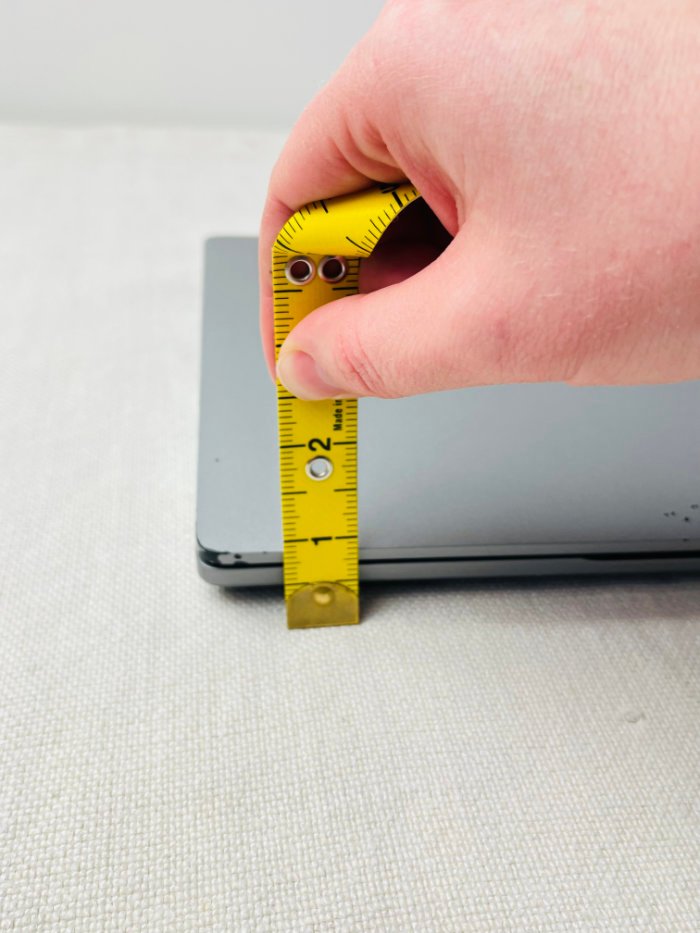
Note
Laptop dimensions vary slightly by brand and model, even within the same screen size. Always measure your own laptop rather than relying on manufacturer specifications.
As the laptop bag will need to be made with lining, interfacing and padding, you need to add ease allowance of 1.5 cm (0.5″) to 2.5cm (1″ ) to all measurements. I added 1.5cm (0.5″) to depth and 2.5cm (1″) to both width and height.
I found it much easier to draft this bag with everything written down first, so I’ve turned my notes into a printable worksheet. You can download it free by subscribing to my newsletter.
Step 2: Drafting the Main Laptop Bag Pattern Pieces
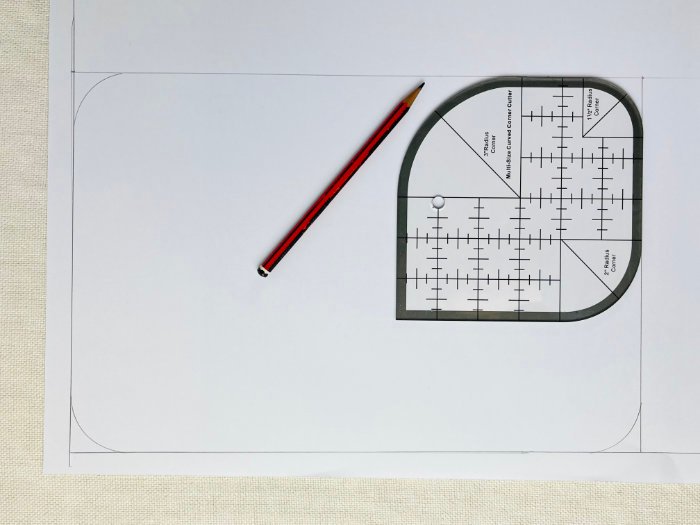
Firstly, draft the rectangle for the main back and front panel piece. This should measure the width and height of your laptop plus the ease allowance. There is no need to add a seam allowance at this stage as you will need to cut the piece for all the pockets.
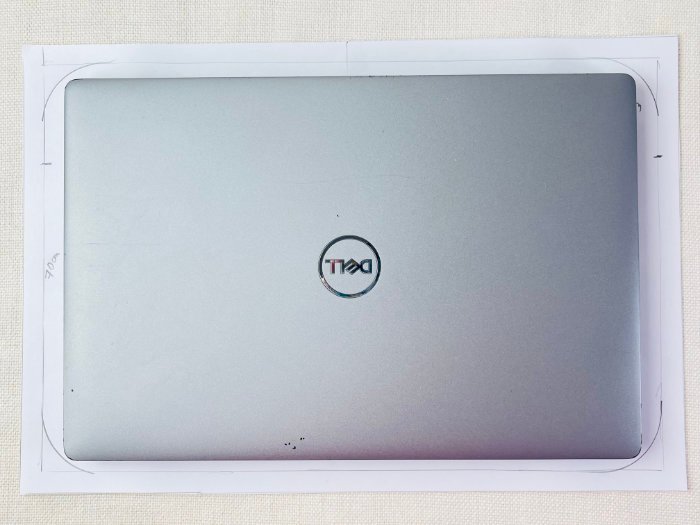
I rounded the corners on the main pattern piece on all four corners using a quilting ruler but you can use any round object with 2.5cm radius or 5cm diameter (1″ or 2″). I am cutting pattern pieces out square but the curve is there for final bag sewing. This way I do not have to worry about getting each individual corner exact on each pattern piece.
Step 3: Drafting the Exterior Pocket Patterns
Front Zipped Pocket
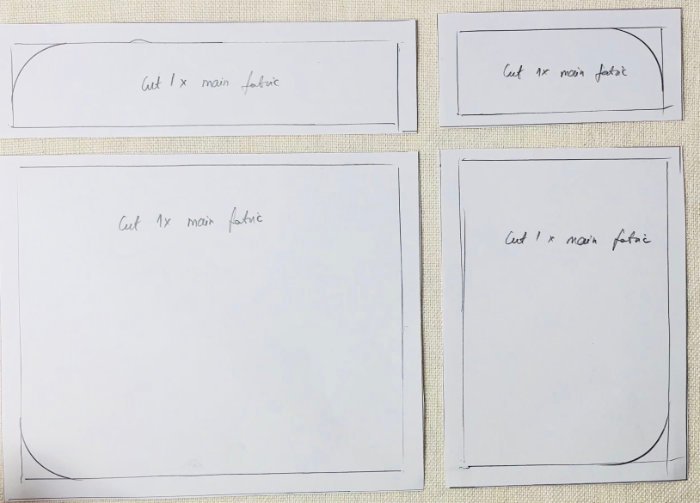
The front zipped pocket will be for cables and I measured 7 cm from the top of the main bag pattern piece and draw a line from side to side. Cut the pattern piece in half along this line.
Place each piece on a separate piece of paper and trace around, leaving enough space to add a seam allowance.
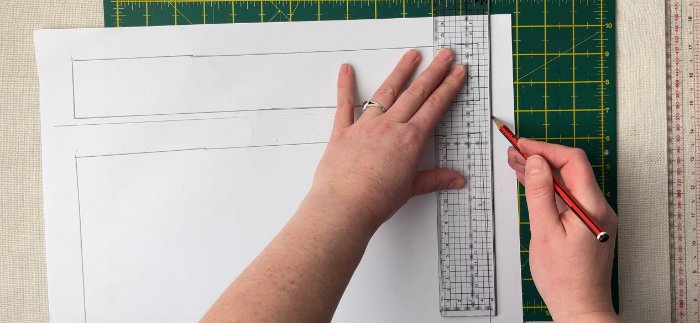
Since we are adding a zip that is not concealed, the zip width that will be visible needs to be taken into account for the final pattern pieces. I measured that my zip is around 3cm wide and with 1cm seam allowance it would leave 1cm visible. So, I either need to take off 1 cm equally from both front pattern pieces, from just one pattern piece or draft a reduced seam allowance. I chose to keep both pattern pieces the same dimensions and add reduced seam allowances along the edge that will have zip.
Oh, I am using 1 cm seam allowance as a base to all my pattern pieces but you can choose different seam allowance. I have written a detailed tutorial on how to choose the correct seam allowance and how to add seam allowances to sewing patterns, which explains this process in more depth.
So, with this is mind, I am adding 1 cm seam allowances on three edges and 0.5cm seam allowance along the edge that will have a zip inserted.
I added rounded corners on the seam line on all laptop bag’s outside corners.
Back pocket pieces
Next, I placed together the original pattern piece that I cut in the previous step. Then drew a vertical line splitting into two parts, with right side small enough to fit my mobile phone with a little ease. I worked out that 15cm (5″) should be sufficient to fit my hand. As I was using the phone for filming, I used my calculator as a guide for the width.
Next, cut the pattern pieces along the drafted line, to create 4 separate pattern pieces.
Then place all pieces on a clan sheet of paper and trace around with space for seam allowance. You will need to use the same logic for seam allowances as for the front pocket piece. Therefor, I added 0.5cm seam allowance for the edges that will have zip and 1cm seam allowance to all the other edges. Cut out the pattern pieces.
Next, I added rounded corners on all the seemliness on the laptop bag’s outside corners to help me piece the pattern pieces. I left the corners sharp instead of cutting rounded corners.
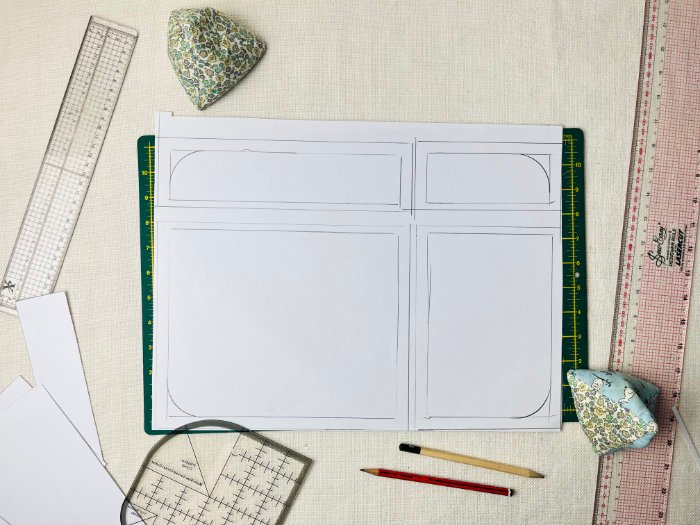
My plan is to sew the front and back panel to a lining on outer edges and then stitch through the back at the two pocket seam line to separate the pockets. What I did not realise at the drafting stage that I do not separate top part as there is one zip with two pulls to separate the section. Originally I thought I could make it two separate zips but it would not work in practice because of the bulk in the intersection.
You could keep the pattern in four parts for colour blocking though.
Step 4: Drafting the Laptop Bag Lining Pattern Piece
The lining piece either need to be redrafted or traced from the original by piecing together the cut pieces. I went for the latter.
Round the corners and add seam allowances.
Drafting pocket for the lining
If you are adding a pocket to inner lining, you will also need a pattern piece for pocket. I have not decided yet whether I want a patch pocket or a welt pocket so I am making notes for both dimensions. The finish width of the pocket is going to be W 14 x H 11 cm (5.5″ x 4.5″).
- Patch pocket – pattern piece will need to be W 16 cm x H 16cm (6.5″ x 6.5″)
- Welt pocket – pattern piece will measure 20 x 32 cm (8″ x 12.5″)
Step 5: Drafting Laptop Bag Gusset Sewing Pattern
Then, on both sides of the lining, mark a location for the zip for the main bag. I positioned the zip location at 7cm from the top on both sides. This is 1 cm below the pocket zippers to reduce bulk at these lines. To be fair, I did not think of the bulk when I was drafting the pattern piece but I am glad that my gut instinct told me to go lower. It probably would benefit more with lower marks but I am ok with this location.
Next, measure around the lining’s lower edge along the seam line, from mark to mark. This is going to be the length for the gusset. The depth of the gusset will be the depth of the laptop bag plus ease allowance as measured earlier. Both measurements will need 2x seam allowance added.
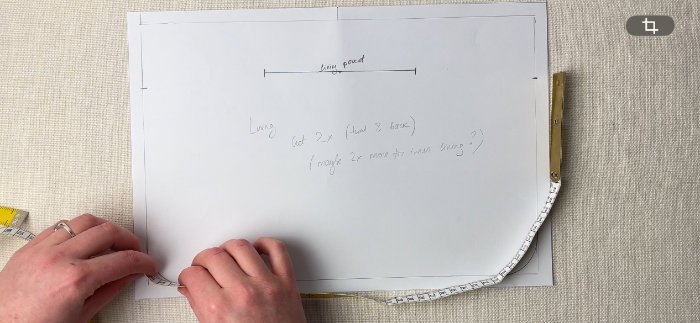
Measuring the gusset length directly along the seam line ensures accurate alignment around curved corners, which is critical for structured bags like laptop cases.
On my pattern, the length of the gusset is 70cm and width is 4cm. So the pattern piece for the lower gusset is 72 x 6 cm. I am not drafting a separate pattern piece as the gussets dimensions can easily be drafted directly on the fabric. Instead, I wrote the requirements on the lining piece.
You will also need to draft the gusset for the upper bag piece that will have zipper in the middle. Measure the upper part of the lining along the seam line, on the curved corners from mark to mark. This is going to be the upper gussets length (plus the zip length that you will need). The depth combined with the visible zip section is the same as the lower gusset.
How to work out visible zip width
Measure the total width of the zip. Subtract 2 x seam allowance or 2 cm, whichever is smaller.
I worked out that the zip will give 1cm, so that leaves 3 cm of total 4 cm width to split into two equal gusset pieces. Add 2x seam allowances to both length and width dimensions. So, with gusset pieces measuring 1.5 x 45cm, the pattern pieces will need to be 3.5cm x 47cm. Similarly to the lower gusset, I did not draft the pattern piece but made a note on the lining that I will need two pieces of exact measurements.
Step 6: Drafting Handles and Shoulder Straps Sewing Pattern
To draft the handles and shoulder strap, I measured the length and the width of the laptop bag I already own. The dimensions for the handles and shoulder straps are:
- shoulder strap pattern with seam allowances – 135 cm x 5 cm (53″ x 2″)
- pattern for handles – 38 cm x 5 cm (15″ x 3″)
The shoulder strap and the handles will need interfacing and an optional padding so it is best to cut them little bit wider than you think you need them as the extra padding will make the straps feel and appear narrower.
The width of the shoulder strap also depends on the measurements of the swivel clasps and strap sliders. While the current laptop bag had wider swivel hooks, mine are narrower so I had to adjust the width of the shoulder strap to match.
Step 7: Draft zip ends and D-ring tabs
To reduce the bulk in seams near zips, I suggest that you use zip ends. You will need draft a separate pattern or make a note on the lining pattern (the largest) for the zip end tabs that are the width of the zip wide and 3 x the seam allowance as a minimum. You can cut the pattern pieces bigger and then trim off the excess fabric. Each zip will need four tabs (two on each end).
The D-ring tab will be needed to attach the shoulder strap. The width of the D-ring tab depends on the width of the D-ring you plan to use. Mine are 2cm wide so I am drafting a rectangles that are 4cm wide and 9cm long.
Step 8: Testing the Paper Pattern
Before jumping to cutting the fabric, make sure that the pattern fits on your laptop and that there is enough ease left on either side of it to accommodate the bulk of the fabric. If you feel up to it, sew a test laptop bag from a cheaper fabric.
Step 9: Sewing Order Overview
I will have a separate sewing post but this is the general order of sewing the bag together:
- Cut the fabric pieces for each pattern piece (main fabric, interfacing, soft padding, lining)
- Fuse the interfacing to outer pieces
- Cut and prepare the zips. Cut fabric for zip ends to reduce the bulk in seams
- Assemble the pieces for the zip pockets first
- Sew the zip pockets to the lining and padding
- Assemble the top gusset with zip (and zip ends)
- Sew the top and bottom gussets together, add loops and D-rings for shoulder strap
- Sew an inner pocket to the lining (either a patch pocket or a buttonhole pocket)
- Assemble and sew inner lining if chosen
- Sew the outer pieces to the gusset to assemble the outer bag
- Join outer and lining pieces together
Common Laptop Bag Drafting Mistakes I Learned the Hard Way
These are drafting issues I personally ran into while testing the pattern, and addressing them early will save you time and wasted fabric
The hardest part was to figure out the outer pocket placements and the inner pocket dimensions for welt pocket. I probably spent most time truing to figure out how the welt pocket should work in a bag compared to the rest of the pattern.
I had to redo the calculations for the upper gusset pieces as I kept adding just one seam allowance. The bag hardware also needed to be considered that ended in reworking the pattern measurements for the shoulder straps.
Fortunately I had already considered that zip will add extra height to my pattern pieces so I adjusted the measurements early on.
FAQ: Drafting a Laptop Bag
Downloadable Resources
To make the drafting process easier, I turned my working measurements and calculations into a printable laptop bag drafting worksheet.
Final Thoughts and Conclusions
This tutorial documents my full process for drafting a custom laptop bag sewing pattern based on real measurements and practical testing. Drafting the pattern first allowed me to plan pocket placement, seam allowances, and bulk management before cutting fabric.
In the next post, I will show how to sew the laptop bag step by step using this drafted pattern, including zipper installation, padding, and final assembly.