In this tutorial I will show you how I apply a reverse appliqué to a T-shirt for my child’s School’s Number Day using a standard sewing machine. It is a fantastic upcycling technique and an easy way to add visual interest to a plain or worn T-shirt.
I have been sewing garments and drafting patterns for years, and reverse appliqué is a technique I regularly return to for repairing, customising, and upcycling knit garments. This tutorial reflects real-world sewing decisions, including small mistakes and how to fix them—so beginners can follow along with confidence.
It has been a while since I done a reverse appliqué so this is also a refresher project for myself. I will share with my revelations and suggestions along the way for a beginner sewing project.
Prefert o watch instead? Here is my quick Youtube short: https://youtube.com/shorts/YtgNcFGrlP8?si=kH5_0E9wao7Fh1Sf
What Is Reverse Appliqué?
Reverse appliqué is a sewing technique where a contrasting fabric is placed behind the main garment, stitched into a shape from the right side, and then the top fabric is cut away to reveal the fabric underneath.
Unlike traditional appliqué—where a shape is sewn on top—reverse appliqué creates a cut-out effect that looks integrated into the garment rather than layered on top.
This method works really well on T-shirt, especially if there is a hole in the T-shirt that you want to cover up. It is simple beginner friendly project as you can cover mistakes fairly easily.
Why Reverse Appliqué Is Perfect for School Number Day
The reversible applique helps to create a unique apparel for School Number Day. The appliqué is durable for washing and you can reuse the T-shirt for the next child or use it up daily.
I am using an old T-shirt but you can sew a new T-shirt following my tutorial and add appliqué to it to jazz up the T-shirt.
This makes reverse appliqué ideal for school number day outfits, handmade kids clothing, and durable DIY T-shirt customisation.
Materials & Tools Needed
For this beginner friendly sewing project you will need these materials and tools:
- T-shirt (pre-washed and pressed)
- Contrast fabric (knit or woven – a knit fabric will add some stretch while woven will limit the natural movements but is suitable for oversized T-shirt and in areas such as hem that do not require a stretch)
- Fusible knit interfacing to stabilise the T-shirt
- Scissors, pins, removable fabric marker (soap, erasable fabric pen, chalk)
- Needle and thread to baste the contrasting fabric to the T-shirt
- Paper and pen to draft the design
- Heat transferrable pencil (optional)
No embroidery machine required
Preparing the Number Design
Choosing Number Size & Placement
I am going to add the reverse appliqué design on the front central section to make it easier to sew as the garment is quite small. I want it to be quite visible and bold while maintaining comfort. For a larger T-shirt you can place the numbers wherever you please as long as you can fold up the back layer and access with a sewing machine. For hand stitching the placement of the reverse appliqué is less concerning.
Regardless of the transfer method that I will discuss below, you need to draw the life-size applique design on a piece of paper. Alternatively, you can draw, purchase or download a free design which you then need to print to exact size requirement.
I drew my own design by looking up inspirations on the internet.
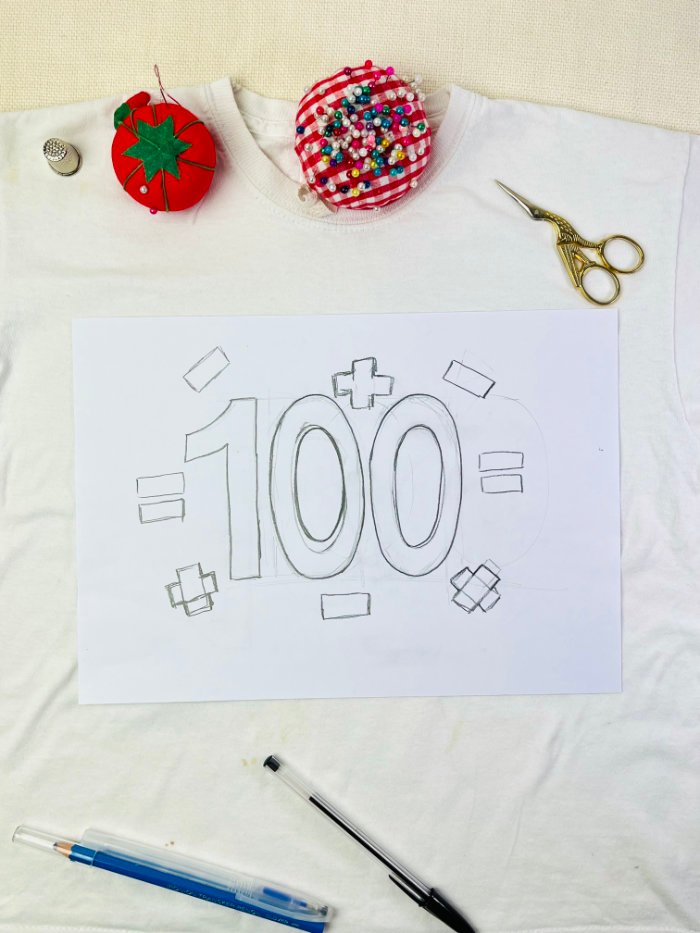
Transferring the Number
You have three options for transferring the design onto the T-shirt:
- Freehand
- If you have a steady hand and are good at drawing, you can draw the reverse appliqué design directly on the T-shirt
- Template trace
- You can cut out the design shapes and use them as templates to trace onto your garment
- Heat transfer pen
- Alternatively, trace the reverse of the design with a heat transferrable pencil on the back of the paper.
I went for the heat transfer pencil option as I already had a heat transfer pencil in my stash. I stuck the design on the window with a masking tape and traced the design that I now could see.
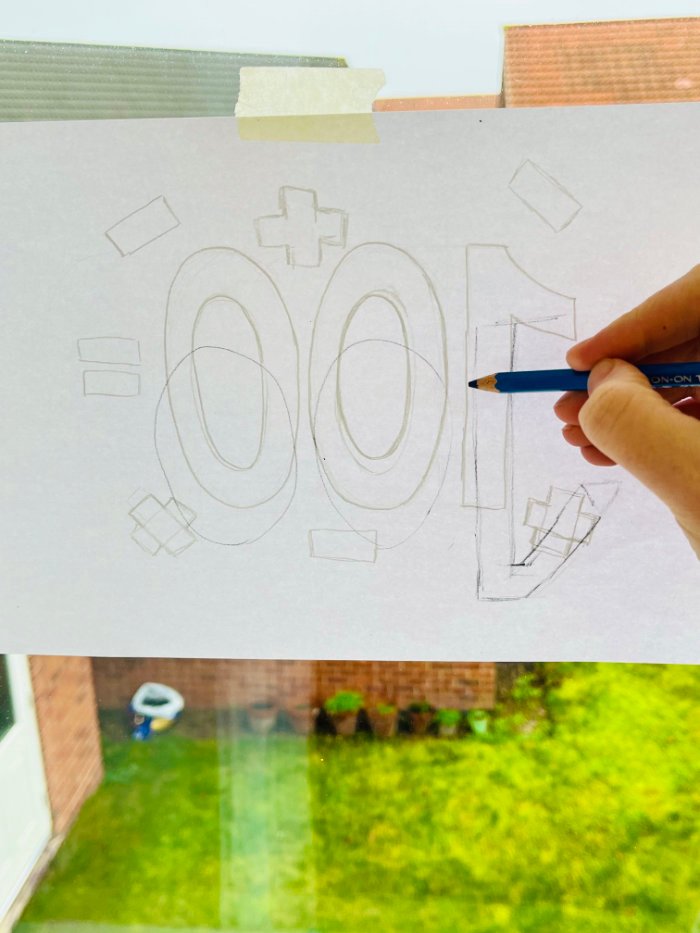
Then I positioned the drawing onto the right side of the T-shirt and transferred with a hot iron. Unfortunately, I missed one corner and had to trace it freehand. One could say that I I went for two design transfer options 🙂
At this point I also realised that I cannot apply a fusible interfacing behind the traced image as I had used heat erasable marker! Oh, well, let’s see how the reverse applique turns out without the stabilisation.
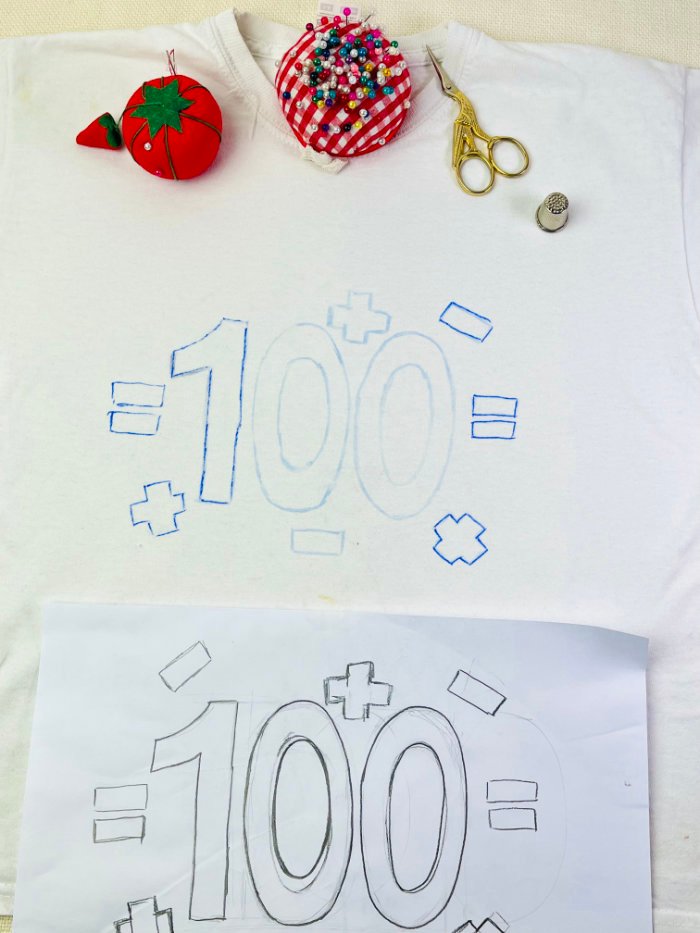
How to Sew Reverse Appliqué on a T-Shirt (Step by Step)
With the design now drawn onto the T-shirt, lets dive into the sewing the reverse appliqué.
Step 1 – Layer and Secure the Fabrics
First, position the contrast fabric in the T-shirt, behind the appliqué outline, with the right side of the appliqué fabric facing the wrong side of the T-shirt. You want the contrast fabric’s straight grain to match the straight grain of the T-shirt. This is not mandatory but will help with the stretching and maintaining the right shape throughout the garment washes.
The piece of the contrast fabric that I used was too little for a directional match so I did not heed my own advice here.
Next, secure the fabric in place with pins. As I tend to accidentally stab myself with pins way too often, I hand baste the fabric in place and remove the pins.
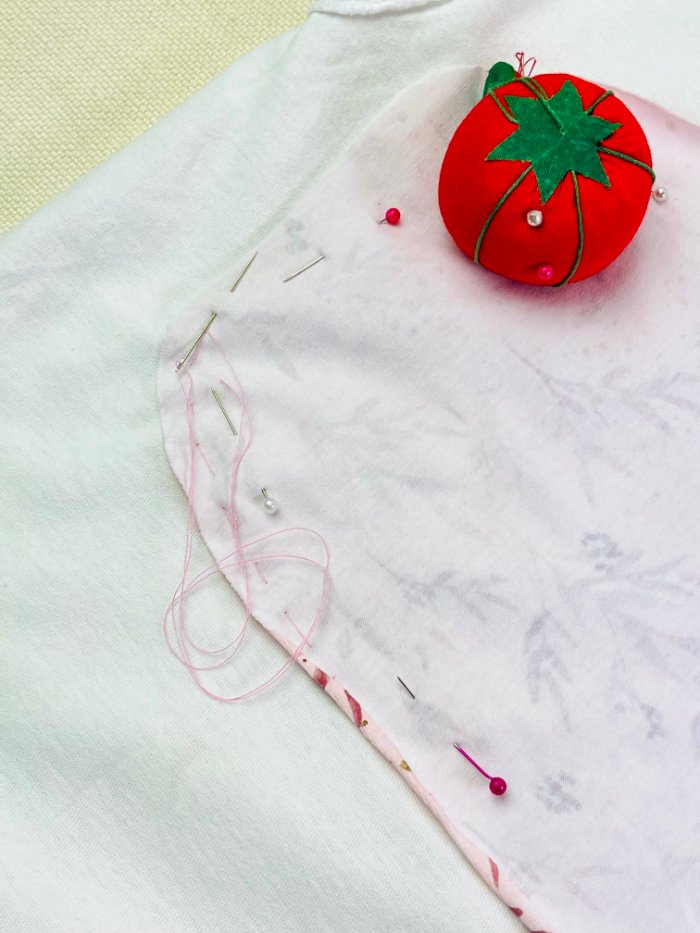
Step 2 – Stitch the Reverse Appliqué Design
Once the contrasting fabric is secured in place, you can get into the sewing. At this point you ned to make a decisions whether you want to have raw edges to your reverse applique or you would like to cover them. For raw edge, you will need to use a decorative stitching at this stage. If you want to enclose the raw edges once the applique is cut, then a straight stitch line is the best choice at this step.
I personally totally forgot to assess the final look before sewing so I dived straight into the zig zag stitch.
For raw edge finish you can use any decorative stitch that you want that is easy to cut around. I tend to secure the larger appliqué shape with a straight 2.5mm stitch and then stitch over with a narrow and short zig zag stitch. The size of the zig zag stitch is 3mm wide and 1.2mm long. My sewing machine has a lot of embroidery stitches on it but I very rarely use anything beyond zig zag and straight stitch!
When you sew around curves or corners, you will need to stop sewing. Lift the presser foot up while keeping the needle down in the fabric, to stop it from shifting. Then pivot the T-shirt to readjust the curve or corner, lower the presser foot and continue sewing. Backstitch when you reach the beginning of the sew line.
You do not need to cut the threads when moving from the shape to shape, but make sure that the threads between the shapes are long enough to stop puckering.
Step 3 – Cut the T-Shirt Layer to Reveal the Appliqué
Once all the design has been stitched, you can get to the fun bit of cutting the T-shirt layer off to reveal the contrasting design below. You need sharp scissors to get close to the stitch line. The applique duck beak scissors are the best but I did not have any so used just basic embroidery stark scissors.
To start cutting, carefully snip in the middle of the shape that you want to cut off, without cutting through the decorative contrast fabric underneath. This will give you space to fit the scissors to cut the T-shirt.
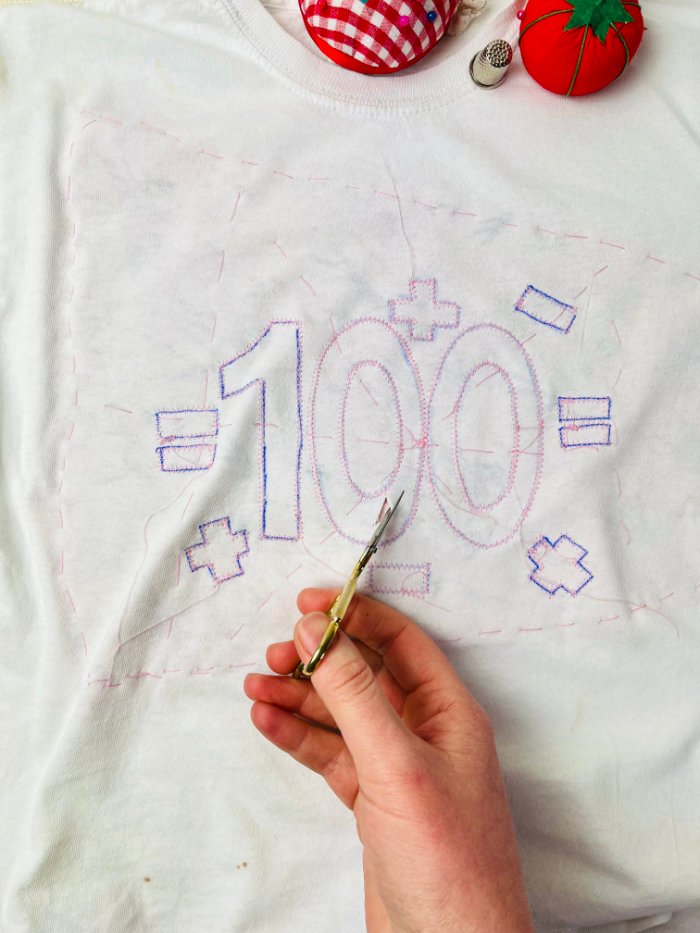
Be careful not to cut the stitch lines when you get close to the stitching. You want to cut as close as possible but leave a few mm for the stitches to grab onto.
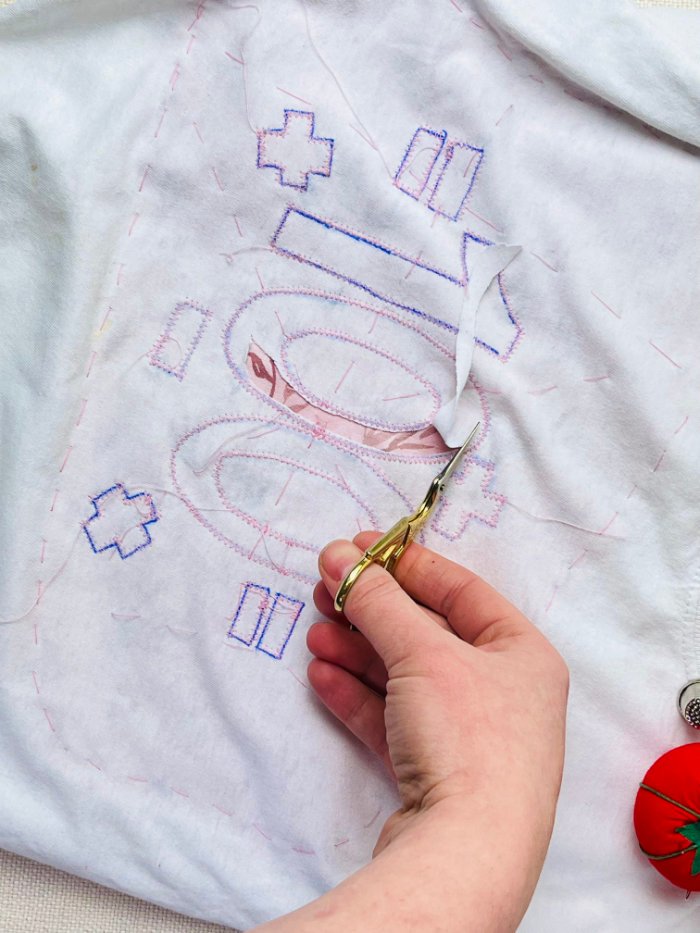
Step 4 – Finish the Edges
If you used a zig zag or decorative stitch in Step 2, then you can leave the edges raw. T-shirt jersey does not unravel but even with unravelling it would give some nice rustic look over time.
However, if you used a straight stitch only, you should use a decorative or zig zag stitch to sew over the raw edges to prevent the fabrics from unravelling from being secured only with one line of stitching. Use a short length decorative or zig zag stitch to capture the raw edges and hide the straight stitching.
Step 5 – Trim the backing fabric
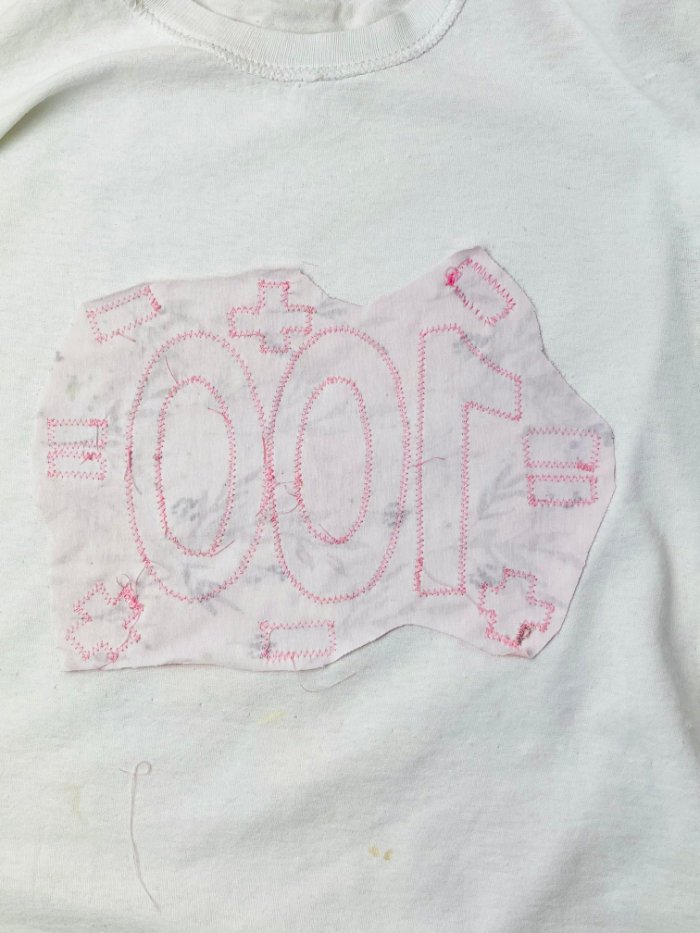
Once the design is complete, you can trim back the excess contrast fabric on the reverse of the T-shirt, to prevent fabric rolling. Do not cut too close to the stitch lines to maintain the design integrity.
Beginner Tips for Reverse Appliqué on Knit Fabric
When sewing reverse appliqué on knit fabric, fabric control matters more than stitch choice. The biggest challenges when sewing a reverse appliqué is to prevent the fabric from moving and creating tunelling (when the fabric bunch up between the zig zag side stitches).
Based on my experience sewing knit garments, the most reliable way to prevent tunnelling is to use a walking foot, a teflon non stick pressure foot or reduce presser foot pressure if your machine allows it. It is good idea also to use a fusible wash away stabiliser or hand based the contrast fabric across the design. Do not go overboard with handbasting as the process itself can cause fabric shifting and bunching. Just do a few straight stitch lines across the appliqué in couple of places in both vertically and horizontally.
If you are unsure on how the fabric will behave, do a test sew in inconspicuous place or on a separate similar fabric offcuts.
My final advice is to make sure that you use a new needle that is suitable for knit fabrics – a stretch or ballpoint needle.
Common Mistakes & How to Fix Them
These are the most common mistakes when sewing reverse appliqué, along with practical ways to avoid them.
- The final appliqué is too narrow. Either draft the design to be wider and “fatter” or use the design lines as the guideline that you cannot sew onto, always sewing on the part that will not be cut away.
- Fraying edges. Complete the decorative stitching after you have cut away the top fabric layer.
- Fabric stretching out. Use the wash away fusible interfacing or hand baste the fabric to stabilise the materials. Use similar weight and stretch contrast appliqué material.
- Uneven edges. Use appliqué scissors or cut from the side rather with the tip of the scissors.
Variations & Ideas
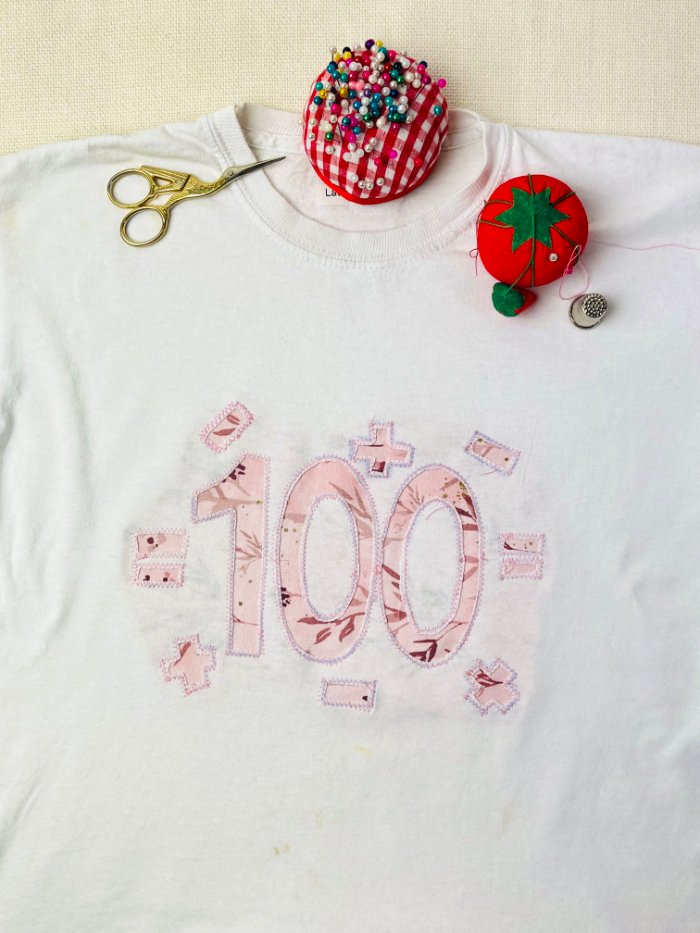
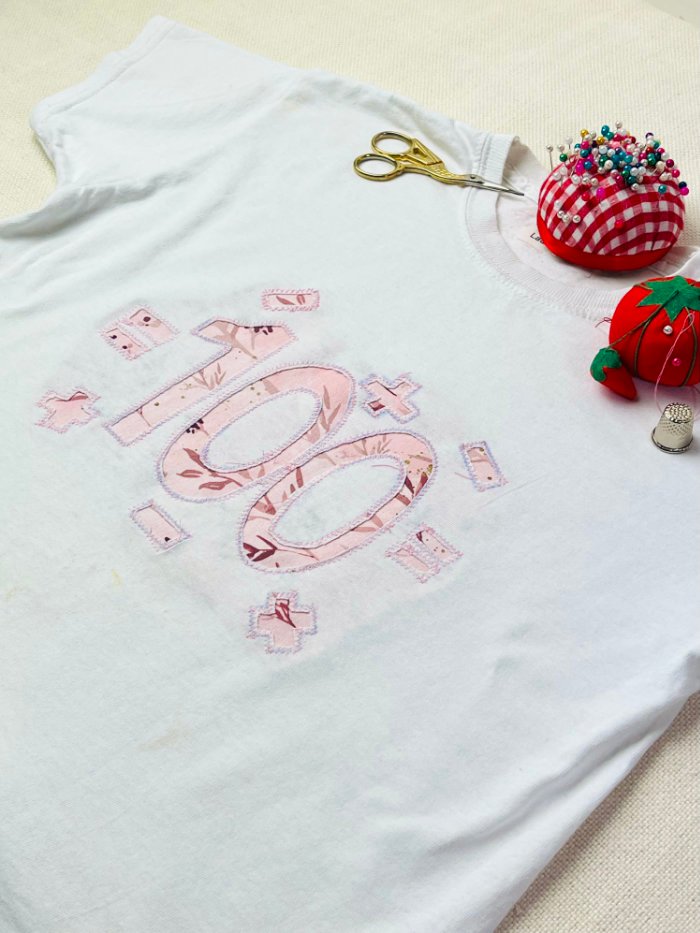
You can mix various appliqué designs on the T-shirt. I went with the number 100 and added mathematical symbols to add interest. For even more interesting outcome, you can mix reverse appliqué with the traditional appliqué.
If you enjoy scrap-based projects, this technique pairs well with patchwork sewing tutorials and other fabric upcycling projects. To achieve a scrap fabric look, you can sew a patchwork contrast fabric first, like I did in this patchwork coaster tutorial.
Can You Do Reverse Appliqué Without Fusible Web?
You can do the reverse applique without a fusible web or fusible interfacing. To stabilise the fabric, hand baste the contrast fabric to the T-shirt and use wider decorative stitch to narrow zig zag stitch. Do not cut off too much of the backing fabric to maintain the integrity.
If your garment or the appliqué fabric is made of softer and lighter fabric, I would recommend to use the fusible interfacing to ensure that the design does not unravel.
Final Thoughts + Encouragement
I had a lot of fun when sewing th reverse applique. It was a quick project that took less than 40 min, of which most was spent setting up the sewing machine and drafting the design. It is a perfect last minute project for the school event as you most likely have all the necessary tools in your house.
Reverse applique is quick and easy project that gives lots of room to hide the mistakes or present them as intentions! I encourage to try it out if yo ahem never done it to bring back life to a boring or damaged T-shirt or any other garment. You are not limited to wearable garments either. Think of towels, beddings or pillow cushions that could have a new life!
Reverse Appliqué FAQ
Conclusions
Reverse appliqué is a fast, forgiving sewing technique that works especially well for beginners and upcycling projects. If you have an old or damaged T-shirt, this is an easy way to give it a second life—no special tools required.
If you try this tutorial, leave a comment below or save it for your next handmade clothing project.
About the Author: Pattern Drafting & Garment Sewing

I’ve been sewing for over 30 years and drafting my own patterns for more than a decade. I work almost exclusively with self-drafted patterns, which means I don’t rely on instructions—I rely on understanding how garments fit and come together.
Most of my methods come from figuring things out through testing, adjusting, and breaking down common problem areas using logic and geometry rather than guesswork.
On this site, I share step-by-step tutorials on pattern drafting, garment construction, and sewing techniques to help you create well-fitted, professional-looking clothes from scratch.
👉 Read more about my approach to pattern drafting and sewing here: About Me